Category Archives: Uncategorized

I Wish I Were Lucky and Good

Warning: This post is full of personal information about me, so if you are someone who doesn’t like to listen to people talk about themselves, you might want to skip this one. I will understand. But perhaps you can at least somewhat relate to some of my experiences – and my feelings about those experiences.

You’ve probably heard the expression, “It’s better to be lucky than good.” We say it when someone gets a break for being in the right place at the right time or knowing the right person, rather than being talented enough to get the break on their abilities alone. We express a similar thought when we say, “It’s not what you know, but who you know, that counts.” I like it when good things happen to someone else – except when I wish that someone else were me. I admit it; sometimes I’m jealous of those that seem to get something they don’t deserve or that I deserve more (in my humble opinion). But don’t we all feel that way from time to time? If jealousy were a physical disease, almost all of us would be terminally ill in the hospital.

We often use jealousy and envy interchangeably, but I like the distinction Aristotle made: “Jealousy is both reasonable and belongs to reasonable men while envy is base and belongs to the base, for the one makes himself get good things by jealousy, while the other does not allow his neighbor to have them through envy.” In other words, jealousy is inward directed, and can sometimes motivate us to work longer and try harder, while envy is outward directed, and can lead to hate of another. Using Aristotle’s distinction, I’m not sure I have been envious – where I took steps to prevent someone from getting something I wanted – and although I have never thought I was a jealous person, upon reflection, I have been jealous at times, at love, at work, and at writing.

One of my favorite romantic comedies is My Best Friend’s Wedding.[i] When Julianne learns that her long-time friend, Michael, is engaged, she decides that she loves him, and does everything she can to break up the wedding, including getting another man to pretend they are engaged, hoping to make Michael jealous enough to drop his engagement. But as the story progresses, Julianne must decide if love or jealousy motivates her. Here is a classic scene near the end of the film (spoiler alert):

In my love life, I have never gone through anything quite so dramatic, but I have felt the pangs of jealousy from time to time. I remember one incident in particular. My wife, Janene, had returned from a weekend visiting her sister and told me that, while there, she had run into an old boyfriend. So far, no big deal. But then she told me that she could sense that the former boyfriend still had feelings for her. Fortunately for me, nothing happened, except with me. Someone once said, next to the atom bomb, the greatest explosion is set off by an old flame. Jealousy exploded within me, even though I was the one who ultimately had won Janene’s heart. But it was also a reality check. Although it had been over a decade since Janene and this man had broken up, he still desired her. I realized once again that I had married someone special. And I better treat her that way. Since then, I have not been the perfect husband, but it was not from lack of trying.

The classic family film, Toy Story,[ii] is premised on jealousy. Buzz Lightyear, a boy’s newest toy, threatens Woody’s status as the boy’s favorite. Enjoy this scene where Woody’s and Buzz’s battle for top toy leads to some unintended consequences:

While Toy Story is not set in a work environment, it demonstrates what can happen when peers become jealous of each other. And haven’t you felt similar jealousy when someone other than you got the promotion you thought you deserved? It happened to me. XTO Energy hired me as the number two lawyer in the department, with the promise, if I didn’t mess up the opportunity, that I would be moved to the top spot when my boss retired. Things were working out as planned until ExxonMobil got in the way, which bought XTO three years after I started there. I felt lucky to have kept my job, as typically, a company that buys another will replace existing management with their own people. But I didn’t feel quite so lucky when my boss retired two years later, and ExxonMobil moved one of its own into the top lawyer position instead of me. Sure, my new boss was qualified, but that didn’t stop me from being jealous. Hadn’t I been promised the job when I started? I knew how XTO (and its people) did things better than the new guy. And I believed I was at least as good as, if not the better lawyer. So how did I react to being passed over? Unlike Woody and Buzz in Toy Story, instead of working with the new guy to make XTO a better company, I did the opposite. I shaved my head and grew a goatee, and vowed to work only so hard as required to get the job done. I gutted it out for another six years until retirement, but work was never the same, and I never fully got over those feelings of jealousy. But now I’m retired, and he is not!

As a writer (using that term loosely), I continue to experience some jealousy. I started writing as a hobby back in the early 90s when a woman at work challenged me to write a legal thriller as good as John Grisham’s. And so, I wrote Unrighteous Dominion (you can buy it or download it from Amazon!). I have never talked to any “regular” person that has read Unrighteous Dominion who did not enjoy it (although I’m sure those people exist). But despite praise from many, no publisher or agent got behind it, leaving me to self-publish it (maybe it was ahead of its time, as the premise of it is sexual harassment, and might have gotten more attention in the current “Me, Too” movement). Surprisingly, I have never felt jealousy toward John Grisham. Although I believe Unrighteous Dominion is as well-written as many (most?) of Grisham’s novels, I am happy for any practicing lawyer who makes it as a fiction writer.

But I have never gotten over feelings of jealousy regarding my second book, a sappy little Christmas story called, The Presents of Angels. (You can get it on Amazon, too, but better yet, if you would like a copy, let me know, and I will send you one.) When Unrighteous Dominion didn’t take off like I thought it might, I followed the lead of another writer, Richard Paul Evans. He originally self-published a little Christmas book called, The Christmas Box. He then went to everyone he knew and told them if they bought one copy, he would give them another to give away as a present. That year, I received at least two copies of his book as a present from relatives. His marketing campaign was so successful a leading publisher decided to publish it. Since then, Evans has published over thirty novels, all of which have been New York Times bestsellers. There are more than 30 million of his books in print worldwide, and they have been translated into more than 24 languages. I read The Christmas Box (and at least one other of his novels), and to this day, I cannot understand its success. The Presents of Angels is far superior. I know I’m biased, but many others agree with me. I even got it published by a small publishing company. But the commercial success of The Presents of Angels has been limited. I would have been happy if I had one-tenth of the success of Mr. Evans. I am hoping my jealousy will motivate me to continue to write. That is one of the reasons behind this blog. And the sequel to The Presents of Angels is on the horizon.

The movie, Atonement,[iii] dramatically illustrates the unintended consequences of jealousy. But here, envy, more than jealousy, is involved. [Spoiler Alert!] A thirteen-year-old girl has a crush on her older sister’s boyfriend. When she catches them making love, her envy leads her to accuse the boyfriend of the rape of her cousin, even though she saw the real perpetrator. That one act of envy ends up destroying the lives of both her sister and her boyfriend. The young girl, now 18, tries to make things right in this scene:

But in an interesting twist at the end, this girl learns that it is too late to make things right, and so she attempts to atone for her envy-motivated actions by publishing their story.

One of the saddest unintended consequences of jealousy (and sometimes envy) is that the person you are jealous of often doesn’t know about your jealousy. They continue to live their lives as they normally would, while you are left to let your emotions fester, harming no one but yourself. Richard Paul Evans has no idea I am jealous of him. Janene’s old boyfriend would probably laugh if he heard I was jealous of him since I got the girl. And even if my former boss at ExxonMobil knew I was jealous of him, which he probably does, he was not about to change his position and status to appease my jealousy. My jealousy, then, only hurt me.

One thing to remember is jealousy is a normal reaction to things that happen to us and others. Experience has taught me that jealousy can be a good thing if it motivates you to do something or to do something better, such as improving a skill, talent or craft. But it can also discourage us to the point where we give up on something we do well. And envy only leads to hate and potentially the destruction of other people’s lives. I hope we will always know the difference between jealousy and envy, and only use jealousy to motivate us for the better.


[i] My Best Friend’s Wedding

  • Production Companies: TriStar Pictures, Zucker Brothers Productions, and Predawn Productions
  • Director: P. J. Hogan
  • Screenwriter: Ronald Bass
  • Starring: Julia Roberts, Dermot Mulroney, and Cameron Diaz
  • Release date: June 20, 1997

[ii] Toy Story

  • Production Companies: Pixar Animation Studios and Walt Disney Pictures
  • Director: John Lasseter
  • Screenwriters: John Lasseter and Pete Docter
  • Starring: Tom Hanks and Tim Allen
  • Release date: November 22, 1995

[iii] Atonement

  • Production Companies: Universal Pictures, StudioCanal, and Relativity Media
  • Director: Joe Wright
  • Screenwriter: Christopher Hampton (based on the novel by Ian McEwan)
  • Starring: James McAvoy, Keira Knightley, and Saoirse Ronan
  • Release date: January 11, 2008


I Hate it When I’m Angry

People are going crazy over Colin Kaepernick again. This time, Nike is to blame (or praised, depending on your point of view). Nike just made Mr. Kaepernick a spokesperson for its new ad campaign on the thirtieth anniversary of its “Just Do It” ads. You would have to be living in a far away country if you are not aware of Kaepernick’s protest against racial injustice and law enforcement’s treatment of minorities by his kneeling during the national anthem. Many people, though, have looked at his protest as disrespect for the American flag and the military who protect this country. The announcement by Nike in support of Kaepernick has caused some of those people to boycott Nike and even burn their Nike shoes and socks, while others have stood with Nike and Kaepernick. In short, if we listen to all the chatter, we are racist if we do not support Kaepernick, but if we do, we are disrespecting the flag and the military. There is no middle ground. How did the world get so polarized? Meanwhile, Nike, one advertising expert has estimated, has received more than $43 million in free media exposure.

Sadly, the support for, and outrage against, Kaepernick and Nike is only one example of the times in which we live. If you are a public person, a company selling goods or services to the public, or even a “regular” person who uses social media, it is hard to even breathe without someone praising you or despising you. An executive of Twitter recently had lunch at Chik-Fil-A and posted his lunch choice on Twitter. Social liberals went crazy, calling him all kinds of names and criticizing him for supporting a business whose owners are outspoken against same-sex marriage. How does picking a place to eat mean that you are either for or against LGBTQs? When this particular executive later apologized for his lunch choice, others criticized him for caving to pressure from social media on something as insignificant as his lunch choice. Maybe that’s the point: a lunch choice should be considered insignificant – not important enough to tell the world about it, and not an indication of one’s views on an issue. Similarly, In-and-Out Burgers recently made a $25,000 donation to a GOP candidate. Immediately, the Democratic Party called for a boycott of all In-and-Out Burgers. In short, we have lost our ability to tolerate those with opposing views to our own.

I once thought the world was getting kinder, with the civil rights movement, the Me, Too and equality for women movements, and the growing acceptance of the LGBT community. But lately, we have taken some giant steps backward. Now, it seems, you can’t even order a latte without someone going ballistic, as illustrated from this scene from Kicking and Screaming[i]:

Buddha once said, “You will not be punished for your anger; you will be punished by your anger.” And the resulting punishment of our anger is that turns into hate. Or in the words of Cicero, “Hatred is settled anger.”

It often starts innocently enough. I recently re-watched the thought-provoking film, Changing Lanes,[ii] where a lawyer and an insurance agent have a fender-bender that escalates into a feud. Here is the accident:

Each of the men reacts negatively to the actions of the other until this happens:

Like the characters in Changing Lanes, the anger that we direct against another sometimes starts out having little to do with that person. We are dealing with other issues that we can’t control or just having a bad day in general. When our lives seem to be spinning out of control, we direct our anger against someone or a situation we think we can control. In short, our anger or hatred often is the result of simply trying to understand the world. When life seems to have little meaning or rationality, we want to lash out against someone, something – anything – to help us make some sense of it all. I often feel like Ben Affleck’s character in this additional scene from Changing Lanes:

How do we learn to respect and be more tolerant and accepting of others? Although I may not be the most tolerant person in the world (although I’m trying), here are some things I try to do.

When I disagree with the words or actions of others, at a minimum, I try to realize anger is not the answer. As Lawrence Douglas Wilder said, “Anger doesn’t solve anything. It builds nothing, but it can destroy everything.”

Next, I try to determine what’s really behind the anger and hate. Someone once said, “Anger is a natural defense against pain. When someone says ‘I hate you,’ they mean ‘You hurt me.'” So when I feel like lashing out at someone, I try to remember to take a breath and find the real cause of my building resentment and anger. If my anger is due to the actions of the person I am angry with, rather than lash out, wouldn’t it be better to talk it out?

When talking it out, I have learned it is better to use “I” words rather than “you” words. In other words, I try to express how others’ actions make me feel, and not lecture them on what an idiot they are to believe a certain way. But even this technique is no guarantee that anger won’t result, as illustrated by this clip from This is 40[iii] (sorry for the language):

In closing, please remember two things. Just because we don’t agree with a person’s view on a certain subject does not mean that we support the opposite view. Everything is not black and white; there is a middle ground. And tolerance does not extend to bad actions. All of us are entitled to believe what we want, to our own set of beliefs, values, and perspectives, but our actions should never hurt other people, regardless of their beliefs – or ours.

Being tolerant can be uncomfortable, but even tolerance should not be our final goal. Acceptance and love of others should be what all of us should aspire to. We are taught to love our neighbors as ourselves, even those neighbors that annoy us, those we don’t understand, and those that frighten us. As we take the time to get to know others, their cultures, their perspectives, and why they believe the way they do, I have found that those neighbors become less annoying, and less frightening, which leads to greater understanding, acceptance, and love. That song from the 70s is just as true today as it was back then: “What the world needs now is love, sweet love. No, not just for some, but for everyone.”


[i] Kicking and Screaming:

  • Production Company: Universal Pictures and Mosaic Media Group
  • Director: Jesse Dylan
  • Screenwriter: Leo Benvenuti and Steve Rudnick
  • Starring: Will Farrell, Robert Duvall, and Josh Hutcherson
  • Release date: May 13, 2005

[ii] Changing Lanes:

  • Production Company: Paramount Pictures and Steve Rudin Productions
  • Director: Roger Michell
  • Screenwriter: Chap Taylor
  • Starring: Ben Affleck and Samuel L. Jackson
  • Release date: April 12, 2002

[iii] This is 40:

  • Production Company: Apatow Productions and Forty Productions
  • Director: Judd Apatow
  • Screenwriter: Judd Apatow
  • Starring: Paul Rudd and Leslie Mann
  • Release date: December 21, 2012


Choose Change

I believe in reincarnation!

But not in the Hindu sense. In my last post, I discussed the miracle of birth in connection with the birth of our fifteenth grandchild. Today I want to consider the miracle of rebirth, which, in my mind, is more important than birth. Or, as Mark Twain once said, “The two most important days in your life are the day you are born and the day you find out why.”

Some of my grandchildren have T-shirts that say, “Choose Kind.” That expression comes from the movie, Wonder, where Mr. Browne teaches his students about the precept (sayings to live by) first stated by Dr. Wayne W. Dyer: “When choosing between being right and being kind, choose kind.” One of my favorite precepts is: Do not fear change, for it is an unchangeable law of progress.

I recently retired from 39 years of practicing law. In those 39 years, I changed jobs eight times and moved 12 times. It really wasn’t because I had a hard time keeping a job. Early on, I had adopted this philosophy in connection with new job offers that came my way: everything else being equal, always choose the new job. Why? Because it is through change that we change – or at least have the opportunity to. But change just for change’s sake, is not progress any more than noise is music.

So with my retirement, comes change. We moved into a new home to be closer to most of our kids and grandkids. Moving has been hard, but in the long run, the move will be the easy part. The harder part will be how we handle a new neighborhood, and worse, a new lifestyle. I worry about making new friends, I consider whether I should attend a new church congregation, and I question how to spend my new free time. (I know, “first world” problems.) In short, will I take this opportunity to make some new music in my life, or will I just be making noise? Will I actually experience a rebirth of sorts, or will I be Exhibit A to what Tolstoy once said: “Everyone thinks of changing the world, but no one thinks of changing himself.”

Fortunately, I find some inspiration in movies. I love films where the main characters reinvent themselves for the better: Ebenezer Scrooge in A Christmas Carol (or Scrooge or Scrooged or Ebenezer), Frank Abagnale in Catch Me if You Can, or Jean Valjean in Les Miserables.

Of course, the first thing we must do to make a positive change is to get off our butts and do something, as illustrated by this clip from Into the Wild[i]:

But we never want to confuse motion with accomplishment. Some people (as well as many organizations) experience paralysis through analysis. We are busy, busy, busy analyzing and reanalyzing a situation, but we never decide to do anything about it. So let’s get in motion first, and then worry about whether our movement is accomplishing anything.

Sometimes we don’t know what to do to change ourselves. An easy way to start is to decide the kind of person we want to become and act as that kind of person would. Or we fake it until we make it. It’s a cute little saying, but it actually works.

If we tell ourselves we are a particular type of person and start acting that way, we begin to fool others, and more importantly, ourselves. One of the best examples of this is the classic film, My Fair Lady[ii], where Henry Higgins determines he can turn even the poorest, most backward Cockney flower girl into a princess merely by teaching her how to speak, dress and act correctly. Here is a short clip where Higgins shows off his accomplishment:

If you are old, like me, you’ll remember what Michael Jordan (and Nike) taught us back in the 80’s. If you wanted to be a good basketball player, all you had to do was wear Nike Air Jordan’s. The ads showed Michael Jordan making some impressive play and then told us repeatedly, “It’s gotta be the shoes.” Although many of us bought Air Jordan’s, few of us bought the idea that shoes alone would make us great basketball players. But we still wanted to “be like Mike.” And who is to say that a new pair of shoes won’t do wonders for our self-image? I admit I’m a shoe guy. As a poster I once read says, “Life is short; buy the shoes.”

This talk of shoes reminds me of one of my all-time favorite films, The Shawshank Redemption.[iii] First, here are Andy and Red talking about what they would do if they could change their circumstances:

Andy then decides to “get busy living” by doing something to change:

Like Andy, sometimes we must go through a figurative half-mile of sewer before we can improve. Habits are hard to break; new character traits are hard to build.

Sometimes, the change we hope for remains out of reach. We don’t quite reach our goals. In those situations, we need to remember that often the journey is more important than the end result. In those situations, please remember these inspiring words from Coach Carter[iv]:

Remember that someday is not a day of the week. Let’s choose change today.


[i] Into the Wild

  • Production Company: Paramount Vantage and Art Linson Productions
  • Director: Sean Penn
  • Screenwriter: Sean Penn (based on the book by John Krakauer
  • Starring: Emile Hirsch, Vince Vaughn, and Catherine Keneer
  • Release date: October 19, 2007

[ii] My Fair Lady

  • Production Company: Warner Bros.
  • Director: George Cuker
  • Screenwriter: Alan Jay Lerner (based on the play by George Bernard Shaw)
  • Starring: Audrey Hepburn, Rex Harrison, and Stanley Holloway
  • Release date: December 25, 1964

[iii] The Shawshank Redemption

  • Production Company: Castle Rock Entertainment
  • Director: Frank Darabout
  • Screenwriter: Frank Darabout (based on the short story by Stephen King)
  • Starring: Tim Robbins, Morgan Freeman, and Bob Gunton
  • Release date: October 14, 1994

[iv] Coach Carter

  • Production Company: Coah Carter, MTV Productions, and Expedition Films
  • Director: Thomas Carter
  • Screenwriter: Mark Schwahn and John Gatins
  • Starring: Samuel L. Jackson, Rick Gonzalez and Robert Ri’chard
  • Release date: January 14, 2005


The Miracle of Birth

There is nothing more humbling than holding a new-born infant. I recently had such an experience as one of my daughters-in-law gave birth to a boy baby.  Welcome to your new world Nikko! Nikko’s reaction? He cried, I’m sure, realizing the kind of world he just entered.

My son and daughter-in-law live in rural Virginia, so Janene and I went there to help babysit their son and my son’s son from a previous relationship so Mom and Dad could concentrate on the birth of Nikko. As I have learned from my own experience of having five kids, no one can plan a family’s activities like a new-born baby.

Humorist Don Herold once said, “Babies are such a nice way to start people.” But it isn’t always so pleasant for the mother, as this scene from the film, Baby Mama,[i] illustrates:

Daniella, my daughter-in-law, is a strong woman, both physically and mentally, so I’m sure her labor was not nearly as dramatic. The day after Nikko’s arrival, we took two of our grandchildren to the hospital to meet him. It was my first chance to meet Nikko as well. I felt a bit left out, as during our short visit that day, everyone got to hold Nikko but me. But during the next few days, I got plenty of opportunities to hold and admire my new little grandson. As I did so, I recalled one of my favorite scenes from the movie, Father of the Bride, Part 2,[ii] where both the daughter and the wife of George Banks (played by Steve Martin) deliver on the same day:

George Banks is right. Life doesn’t get any better than that. Here is Nikko. Like all babies, he is beautiful:

Nikko

With his brothers and Dad:

Matt's Family

 As a new parent, you quickly learn there is nothing like having a baby to realize it’s a changing world (pun intended). And one thing parents learn quickly is that the small, beautiful creature we call a newborn soon ceases to be an armful and grows into quite a handful. A significant portion of the childcare for Nikko will be provided by my son, Matt. In his family, Matt is the stay at home parent while Daniella works as a successful doctor at the local hospital. Many people think the so-called traditional family, with a working father and a stay-at-home mother, is the best arrangement for a child. But I have learned the most critical family arrangement is the one that has as many loving participants as possible, regardless of who is bringing in the income. It really does take a village to raise a child effectively – parents, grandparents, siblings, teachers, and others. It sometimes even takes a village to get a child a great haircut as this photo of my grandson, Dad and Grandma illustrates:

Haircut

Because love is the key, biology doesn’t really matter. Love and commitment are more important to a child in the long run, regardless of genes. I love this scene from The Object of My Affection,[iii] which emphasizes this point that you don’t have to be the biological father to accept the responsibility of being one:

I have seen this work in my own family, as one of my other sons and daughter-in-law, first became foster parents, and then adoptive parents, to Dax, one of our 15 grandchildren. Although adopted, you would never know it from the way the entire family loves and accepts Dax. Nothing touches me more than feeling the love among family members, regardless of origin, looks, or abilities. And nothing angers me more than the hurt and abuse – whether physically, mentally or emotionally – of a child.

Experts tell us the first three years of an infant’s life might be the most critical. The Beginning of Life[iv] is an excellent documentary that explores a child’s development during those critical first three years. Babies are much more than just their inherited genes (although that is a large part of who they are). Young children are also shaped by their environment and their relationships to that environment. If we could create a better environment for all newborns, we can radically change the world (and not just their diapers). Here is the trailer:

Netflix has turned this documentary into a six-part series, The Beginning of Life: The Series. If you are a new parent or if you just love babies (and who doesn’t?) I highly recommend investing your time in this series.

One of the greatest things we can learn from a young child is to explore and enjoy being in the moment and admiring the simple stuff. A toddler loves, for example, dropping a spoon from his or her high chair. They love hearing the noise it makes. And they also enjoy watching mom or dad’s reaction. When was the last time we, as adults, found joy in such a simple thing? Sadly, adults are too worried about what happened yesterday, and what could happen tomorrow.

A final shout-out goes to those parents who, for whatever reason, give up a child for adoption. I can’t think of anything harder to do than that. But giving up a child for adoption is one of the greatest acts of love imaginable. In that light, here is my favorite scene from the movie, Juno[v]:

With all the terrible things happening in the world, it is a tough time to be born. Yet I hold great hope for Nikko because of the love of so many people surrounding him.

If only it were so for everyone.


[i] Baby Mama

  • Production Company: Broadway Video, Michaels-Goldwyn, Relativity Media
  • Director: Michael McCullers
  • Screenwriter: Michael McCullers
  • Starring: Tina Fey, Amy Poehler, and Sigourney Weaver
  • Release date: April 25, 2008

[ii] Father of the Bride, Part 2

  • Production Company: Sandollar Productions, Taylor-Made Productions and the Meyers/Shyer Company
  • Director: Charles Shyer
  • Screenwriters: Albert Hackett and Frances Goodrich
  • Starring: Steve Martin, Diane Keaton, and Martin Short
  • Release date: December 8, 1995

[iii] The Object of My Affection

  • Production Company: Twentieth Century Fox
  • Director: Nicholas Hytner
  • Screenwriter: Wendy Wasserstein (based on the book by Steven McCauley)
  • Starring: Jennifer Aniston and Paul Rudd
  • Release date: April 17, 1998

[iv] The Beginning of Life

  • Production Company: Maria Farinha Filmes
  • Director: Estela Renner
  • Screenwriter: Estela Renner
  • Starring: Laura Schichvarger
  • Release date: May 5, 2016

[v] Juno

  • Production Company: Fox Searchlight Pictures, Mandate Pictures, and Mister Mudd
  • Director: Jason Reitman
  • Screenwriter: Diablo Cody
  • Starring: Ellen Page, Michael Cera, and Jennifer Garner
  • Release date: December 25, 2007


Being Your Own Boss

Chuck Borough wrote, “Teach children to be their own bosses at a young age, and they will not follow every little boss they meet on the playground. Be generally their advisors, never their bosses.” I have debated with myself lately whether or not I was a good parent. I think all parents do that at some point, but probably more so as we get older, especially if we see our own kids making some of the same mistakes we made. (If any of my children are reading this, please don’t think I’m referring to you!) One of the greatest things we can teach our children, or better said, help them discover for themselves, is their own self-worth. Stated another way, of all the opinions people have about us, the only one that matters is the opinion we have of ourselves. Sadly, though, most of us determine our own worth by the views others have of us. And so we often live our entire lives to please and gain the admiration of our spouse, our friends, our church, our school, or our community and never end up genuinely pleasing ourselves.

I have always maintained that the most important thing we can do as a parent is to teach our children that they can live without us, or in other words, help them to become independent, functioning adults. In short, we raise our children to be secure enough to leave home but we hope they will want to come back to us – but only for a visit. I always smile when I think of a friend of mine who gave each of his kids a suitcase for their 18th birthday. It was a not-so-subtle hint that it was time for them to make it on their own. Before anyone can live independently at 18, though, they need to learn particular skills before that age. And to me, again, the most important skill a young child can learn is a sense of self-worth. A positive sense of self is best learned as a child, but even as adults we can (and should) develop and expand the good feelings we have about ourselves.

But what, exactly, is self-worth? The dictionary defines it as the sense of one’s value or worth as a person. It is somewhat synonymous with self-respect or self-esteem. Dr. Lisa Firestone points out that self-worth should be less about measuring yourself based on external actions and more about valuing your inherent worth as a person. Here is a clip from Cloudy with a Chance of Meatballs[i] that reminds us to focus on who we really are – not what other people think of us:

In other words, self-worth is about who you are, not about what you did or do. But don’t we all grade ourselves by what we have done, not who we are? When someone asks me to tell them about myself, I respond by saying things like, I’m retired now but I practiced law for almost 40 years. I am married to a wonderful wife, and we have five great children and 15 beautiful grandchildren. I was born in Utah, lived in Colorado, and moved to Texas in 1985. In Texas, we have lived in the Dallas, Houston, Austin and Fort Worth areas. In short, this is what I have done in my life so far. But what I don’t say is, I like to write. I have a dry sense of humor. I love sports and watching movies. I am an “early to bed, early to rise” kind of guy. I like to eat burgers and Tex-Mex. Which approach tells you more about who I really am?

Self-worth should never be confused with self-importance – that we are too important to do menial tasks or associate with certain people. We often find that people who think they are too big for the little jobs are too little for the big ones. Or as someone once said, “When a man starts singing his own praises, it’s usually a solo.”

I started this self-assessment as a parent after watching the documentary, Won’t You Be My Neighbor.[ii] It is based on the life of public television’s Fred Rogers, who hosted the educational pre-school TV series, Mr. Rogers’ Neighborhood, for over 30 years. Here is a trailer for that great documentary:

I was too old to enjoy Mr. Rogers growing up, as I was 15 when his TV show began. My kids never got into him either, preferring Sesame Street instead. Watching the documentary, though, I realized some great things about Fred Rogers, including he was not afraid to get down on a child’s level, but never in a condescending way. He helped kids feel good about themselves. And he spoke the language of love. Here are some of my favorite quotes from Mr. Rogers:

“Knowing that we can be loved exactly as we are gives us all the best opportunity for growing into the healthiest of people.”

“You know, you don’t have to look like everybody else to be acceptable and to feel acceptable.”

“How sad it is that we give up on people who are just like us.”

“Love isn’t a state of perfect caring. It is an active noun like struggle. To love someone is to strive to accept that person exactly the way he or she is, right here and now.”

“As human beings, our job in life is to help people realize how rare and valuable each one of us really is, that each of us has something that no one else has – or ever will have – something inside that is unique to all time. It’s our job to encourage each other to discover that uniqueness and to provide ways of developing its expression.”

I wish I would have repeatedly told each of my children similar messages as they were growing up. So with the aid of 20/20 hindsight, here are a few “wishes” of regret I wish I would have done more of as a parent:

I wish I had more patience to let my kids fail more. I realize that sounds sort of weird, but kids learn by doing, and they learn more from their failures than their successes. I wonder how many times as my kids were learning to tie their shoes, for example, did I step in and finish the job because we were in a hurry to get somewhere. But what message did that deliver to the child? “You can’t do it so I will do it for you.” I sometimes did similar things when playing games or putting together puzzles.

When my kids accomplished something, I wish I would have emphasized the qualities it took to reach the achievement. For example, when they got good grades at school, I would compliment them for being smart. I should have praised them more for working hard, for developing problem-solving tools, for being disciplined enough to get their homework done, as so forth. Those are the skills they would need to succeed later in life. And just being smart, without developing those other skills, is rarely a formula for success.

I wish I never squelched their dreams. I think kids need to develop a sense of reasonableness, but never at the expense of dreaming. Sometimes we, as parents, unknowingly place labels or limitations on our children that unconsciously tell them their dreams are too big. I love this scene from the true story, The Pursuit of Happyness,[iii] which dramatizes this point:

I wish I would have emphasized the positive actions of my children rather than the negative. When you think about it, how often do we, as parents, tell our children no! No!! NO!!! Granted, kids need discipline and boundaries, but I’m sure I punished them more for their bad behavior than I rewarded them for the good things they did. Our kids need more sermons like this one from Chocolat[iv]:

I wish I would have let my children make more of their own choices. Many parents today, including my own children, have learned this simple technique. Let your children choose between two or more acceptable options. Give them choices like, which of these books do you want to read before bedtime? Would you rather have green beans or broccoli with dinner tonight? When we let our children choose like that, aren’t we tell them that we trust them? That their opinions matter? Then as they get older, we should start emphasizing the consequences of bad decisions. We still let them choose but allow them to face the results of those decisions, whether good or bad.

These are simple things, but these techniques will help our children develop their self-worth. All of my kids turned out well, despite my sometimes lack of skilled parenting. I give them the full credit for that. I only hope Janene and I did a few things right along the way.


[i] Cloudy with a Chance of Meatballs

  • Production Company: Columbia Pictures and Sony Pictures Animation
  • Directors: Phil Lord and Christopher Miller
  • Screenwriters: Phil Lord and Christopher Miller
  • Starring: Anna Faris, Bill Hader and Bruce Campbell
  • Release date: September 18, 2009

[ii] Won’t You Be My Neighbor

  • Production Company: Tremolo Productions
  • Director: Morgan Neville
  • Screenwriter: None credited
  • Starring: Fred Rogers, Joanne Rogers and Betty Aberlin
  • Release date: June 29, 2018

[iii] The Pursuit of Happyness

  • Production Company: Columbia Pictures, Relativity Media, and Overbrook Entertainment
  • Director: Gabriele Muccino
  • Screenwriter: Steve Conrad
  • Starring: Will Smith, Thandie Newton and Jaden Smith
  • Release date: December 15, 2006

[iv] Chocolat

  • Production Company: Miramax, David Brown Productions, and Fat Free
  • Director: Lasse Hallstrom
  • Screenwriter: Robert Nelson Jacobs (based on the novel by Joann Harris)
  • Starring: Juliette Binoche, Judi Dench, Alfred Molina and Johnny Depp
  • Release date: January 19, 2001


It’s A Sign

During our trip to New Zealand and Australia, we had many great conversations about some weighty topics. I have been thinking a lot lately about the last issue we discussed: being a person of faith and having a believing heart. I have wrestled with this issue my entire life, trying to determine what kind of God I believe in and how to increase my faith in that God. Please forgive this very personal post, but I hope that expressing some of my musings on this subject might be therapeutic for me and might stimulate some thought and discussion among my readers.

I admire people who tell me that God has a plan for them and that they are placing their lives in His hands. For those people, if something goes right, it was because God blessed them. If something goes wrong, then God needed to teach them something. In one respect, it is an excellent way to live, because it helps to make sense of our chaotic world, as everything that happens does so for a reason. And so, chance meetings or coincidences become all part of God’s master plan.

films that portray miracles. I want to believe in God’s intervention in our lives. In The Cokeville Miracle,[i] for example, when David and Doris Young enter an elementary school and hold students and teachers hostage for several hours before detonating a bomb that only kills the perpetrators, I want to believe the children’s accounts of angels appearing in the school to protect them rather than attributing the deaths of the perpetrators to their own incompetence. But I also wonder why didn’t those angels protect the teachers and students at Columbine, Parkland, Santa Fe, and the many other schools where mass shootings have taken place recently. Why did God apparently answer the prayers of the children of Cokeville but not the prayers of these other victims? Again, in Miracles from Heaven,[ii] Anna Beam, suffering from a rare, incurable disease is miraculously healed following a freak accident. But to those people involved, it’s not a freak accident, but God is intervening in their lives. I want to believe that, too. But why was Anna’s faith rewarded when the faith of so many other sick children appears not to be? About the best I can come up with to explain the randomness of God’s intervention is that, live or die, it was God’s will. I try to take it on faith that God is smarter than I am – that he sees the big picture that I cannot. Or as Isaiah taught, God’s thoughts are higher than mine. I am left to adopt the Ricky Ricardo approach from the old TV show, I Love Lucy, in which he would often turn to Lucy and say, “Lucy, you’ve got some explaining to do.” Maybe someday I’ll have the opportunity to have a similar discussion with God.

Some people will bring them together. The movie, Serendipity,[iii] is based on this premise. Serendipity means finding something of great value when you are not looking for it. In this scene, Eve (Molly Shannon) applies logic to disavow the notion that Sara (Kate Beckinsale) will find her soulmate (John Cusack) through fate since both are engaged to others. Yet, in the end, the five-dollar bill taken from the tip in this scene has a telephone number on it that results in Sara ultimately ending up with her soulmate. It is a fun love story, but hard to swallow in real life unless you are a hopeless romantic:

I believe I found a soulmate in my wife, Janene, and it was definitely serendipitous on my part that I found her. But I am not convinced that God led us to each other or that either of us would not have had a great marriage if we married someone else. Does that make our love any less real or less satisfying?

In this scene from the film, Signs,[iv] the Reverend Graham Hess (Mel Gibson) describes what he sees as the two groups of people in the world: those who experience something lucky and attribute it to God who is watching out for them, and those who believe they were, well, just lucky:

I tend to agree with the two groups of people described by Reverend Hess, but I don’t necessarily believe that everyone in the first group (attributing everything to God) will live with hope while those in the second group (all is chance) will live in fear. I think people in both groups are striving to get through life the best they can regardless of their belief.

While I hope God sometimes has a hand in the things that happen to us, I have adopted more of a Forrest Gump[v] philosophy:

Life just happens, and the important thing is being able to distinguish the difference between what is serious, and what is just life.

Recently, I watched the Broadway musical, Bandstand.[vi] I loved the entire play, but I especially liked this song sung by the mother of the female lead, who learns that her new boyfriend was the cause of her husband’s death in World War II.

  • JULIA (spoken):
  • It was his fault! Ma, he’s here and Michael isn’t and it’s his fault!
  • I want to believe everything happens for a reason-
  • JUNE ADAMS (sung):
  • No, no, no
  • Everything happens, just that
  • Everything happens
  • An event, or a death
  • A catastrophe
  • Any reason as to why
  • Is a reason you supply
  • It just happens
  • Everything happens
  • It’s not fate, no great plan
  • It’s not destiny
  • Putting faith in that cliché
  • Gives your own
  • Free will away
  • When things happen
  • And they will happen
  • You can waste your whole damn life
  • Assigning bits of philosophic meaning
  • To the failures and misfortunes intervening
  • And I’ll tell you what you’ll get
  • Just a lifetime of regret
  • No, no, no
  • There is no reason for why
  • Everything happens
  • It’s the changing of a season
  • It’s a fact
  • And it’s a constant
  • And the only sane response
  • Is to adjust
  • Not to wish it hadn’t happened
  • When it must
  • Now the church will tell you one thing
  • And your friends, perhaps another
  • If I were you I’d listen
  • To your slightly dotty mother
  • Who lost out on her own fair share
  • Of good times and of laughter
  • Listen
  • What matters when things happen
  • Is what happens after

I find great comfort in the words of that song. Maybe what is important is not whether God is directing each step of our lives, but how we react to the things that happen to us, good or bad, irrespective of God’s intervention. If my goal in life is to improve my talents and abilities for the welfare and benefit of my family and others, if my destiny is to become my best, highest self, do I need to know that God is orchestrating every step of the way? I think not.

Perhaps my wife, Janene, said it best: “I have a great deal of faith in the process of life and that living true to my heart and my conscience will be enough. I believe I am a better person for having faced some adversity and done some soul-searching and finding some conviction to stand on my own, with each person finding their own happiness and having their own journey.”

In closing, here is what Anna Beam said she saw while she was unconscious after falling from the tree:

In the final analysis, it doesn’t matter if others believe our personal experiences, as long as we believe them, and act upon them to be better. In other words, it is more important to live a good life than be right. And as Anna says, those that don’t believe us, “will get there when they get there.”

Thanks for listening.


[i] The Cokeville Miracle

  • Production Company: Remember Films
  • Director: T.C. Christensen
  • Screenwriter: T.C. Christensen and Hartt Wixom
  • Starring: Jasen Wade, Sarah Kent, and Kimball Stinger
  • Release date: June 5, 2012

Miracles from Heaven

  • Production Company: Columbia Pictures, Affirm Films, and Roth Films
  • Director: Patricia Riggen
  • Screenwriter: Randy Brown (based on the book by Christy Beam)
  • Starring: Jennifer Garner, Kylie Rogers, and Martin Henderson
  • Release date: March 16, 2016

[iii] Serendipity

  • Production Company: Miramax, Tapestry Films, and Simon Fields Productions
  • Director: Peter Chelsom
  • Screenwriter: Marc Klein
  • Starring: Kate Beckinsale, John Cusack, and Jeremy Piven
  • Release date: October 5, 2001

[iv] Signs

  • Production Company: Touchstone Pictures, Blinding Edge Pictures, and Kennedy/Marshall Company
  • Director: M. Night Shyamalan
  • Screenwriter: M. Night Shyamalan
  • Starring: Mel Gibson, Joaquin Phoenix, and Rory Culkin
  • Release date: August 2, 2002

[v] Forrest Gump

  • Production Company: Paramount Pictures
  • Director: Robert Zemeckis
  • Screenwriter: Eric Roth (based on the novel by Winston Groom)
  • Starring: Tom Hanks, Robin Wright, Gary Sinise
  • Release date: July 6, 1994

[vi] Bandstand

  • Lyrics by Richard Oberacker and Robert Taylor


No Worries

As many of you know, I started my retirement in style by spending 15 days in New Zealand and Australia. So “G’day, mate” (pronounced “good eye, mite”), the typical greeting in Australia, and “Kia ora,” which is Maori for “hello.” This post will be a little different from the usual, as I want to share my impressions of these two great countries. But I’ll throw in a few movie references, and even a photo or two. (A big shout out goes to Martie Mumford, my sister-in-law, who acted as our group’s unofficial historian and photographer, and a big thanks to Martie, Tom, Lynda, Mike and my beautiful wife, Janene, for making the trip so enjoyable. We spent every moment of the 15 days together and got along great, despite some intense discussions on lots of serious subjects. The biggest problem we had was trying to decide where to eat.)

Being in the Southern Hemisphere, New Zealand and Australia were in the middle of winter. But even in winter, New Zealand reminded me a lot of Hawaii. Their natural parks system protects one-third of the country’s flora and fauna. Here are a couple of photos to show you what I mean:

20180612_110338

20180613_151507

Auckland is New Zealand’s largest city and is quite cosmopolitan. Outside Auckland, the country is mostly agricultural. Only five percent of New Zealand’s population is human; the rest are domesticated animals (mostly sheep and cattle). In fact, there are more vending machines in Japan than there are people in New Zealand. As crazy as it sounds, the thing that impressed me the most about New Zealand’s cities were the playgrounds. Take a look at these photos:

20180615_105102

20180615_105659 (2)

Of course, in the “States” (as the U.S. is referred to by those down under), no one would dare install most of the equipment found at a New Zealand playground due to liability concerns. But I understand the New Zealand personal injury system is much different than ours. It is similar to our worker’s compensation, where people who are injured are compensated at a set rate rather than relying on a judge or jury to impose pain and suffering and other damages. If the U.S. adopted such a system, we could do away with a significant portion of the lawyers in this country. (I can say that now that I’m retired!)

New Zealanders (or Kiwis, as they are known) are proud of the fact that there are only four types of poisonous spiders in New Zealand, three came from Australia, along with the black widow from America. And there are no snakes, so Indiana Jones would love New Zealand. When it comes to New Zealand and movies, most people think of the Lord of the Rings trilogy and the Hobbit movies, the filming of which brought over $200 million into the New Zealand economy – that’s over $40 million per person! But when I think of New Zealand movies, I think of Moana and Whale Rider, which give us a greater understanding of New Zealand’s Maori heritage, and my favorite New Zealand movie, The World’s Fastest Indian,[i] which is the true story of New Zealand native, Burt Munro, and his quest to break the land speed record on a motorcycle. It is a gem that, unfortunately, most people have never seen. Here is one scene from the film which I can relate to, as to reminds us never to underestimate the power of an old coot:

When we landed in Australia, the country felt like home to me. I suppose that was because I had served a two-year church mission there many years ago, and the landscape reminds me a lot of the mountain west of the United States. Like New Zealand, Aussies drive on the wrong side of the road, which is the left side. My brother-in-law, Tom, did almost all of the driving in New Zealand, while I did most of the driving in Australia. It does take some getting used to. The hardest parts were to remember which side of the car the steering wheel is on (I got in the wrong side of the vehicle at least twice) and which side of the steering wheel the blinker is on (I was continually turning on the windshield wipers when I wanted to signal a turn). And after we returned to the States, I continued to confuse the windshield wipers for the blinker. In Australia, you not only drive on the left side of the road, you must walk on the left side of a sidewalk as well. In fact, it is technically illegal to walk on the right side of a footpath there.

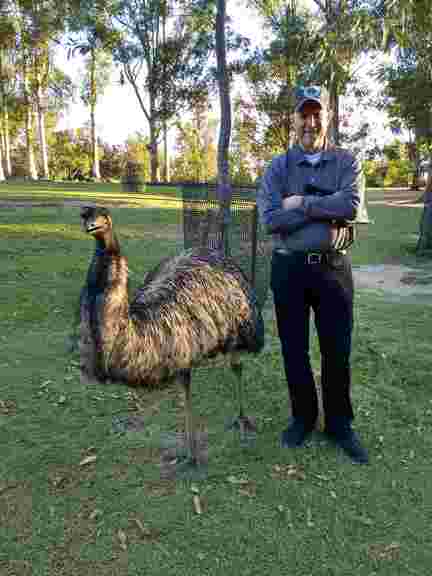
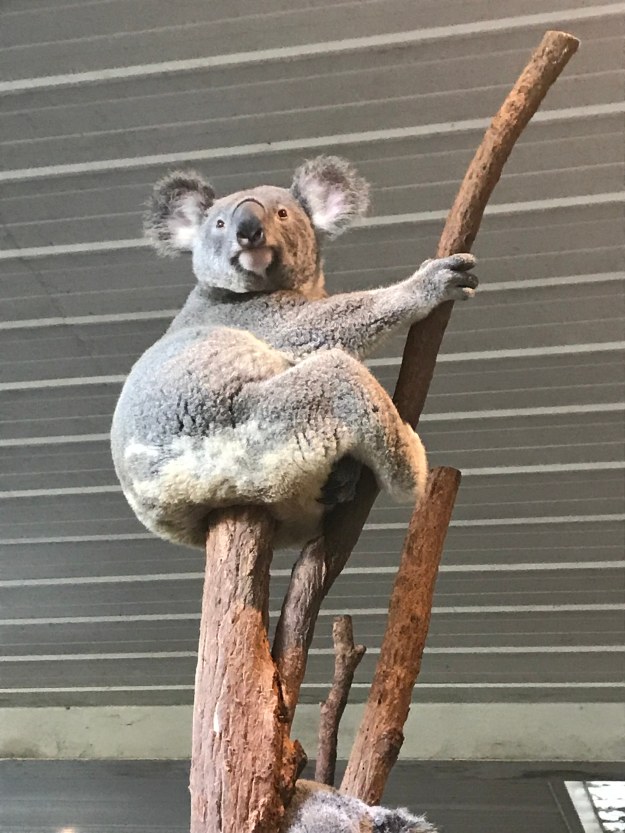
One of the things Australia is known for is their animals. The Tasmanian devil looks like a giant rat, and the wombat’s poop is square-shaped (that sounds painful). But of course, most people think of these Australian animals:

IMG_20180615_231225770_HDR

20180616_162325 (2)

IMG_1592

Neither the kangaroo nor the emu can walk backward, so Australia put them on its coat of arms to signify that the country is always looking forward. But Aussies are happy to eat their national animal and bird. And we joined right in, enjoying pizzas topped with both kangaroo and emu (as well as crocodile). And you can buy kangaroo and emu at almost any butcher shop.

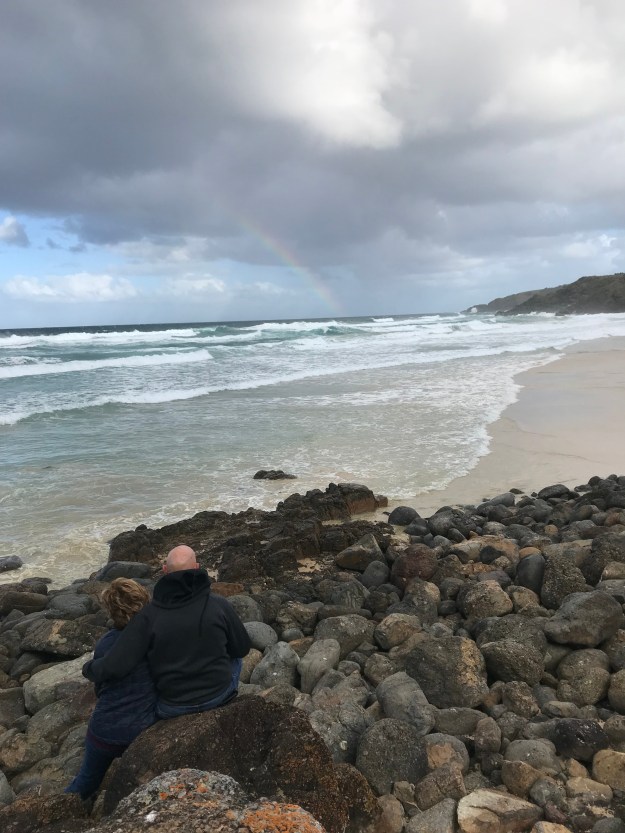
Similar to New Zealand, Australia has three times more sheep than people, and 25 percent of the population was born in another country. More than 80 percent of the people of Australia live within 70 miles of the coast. And a beautiful coast it is!

IMG_1657

If you visited a different beach in Australia once a day, it would take you 27 years to see them all. One of the beaches we visited was beautiful Byron Bay, next to Point Byron, which is the most easterly point of Australia. It has one of the most picturesque lighthouses anywhere:

20180619_161154 (2)

When I saw this lighthouse, I immediately thought of one of my favorite movies set in Australia, The Light Between Oceans.[ii] It is the story of a lighthouse keeper and his wife who rescue an infant from a boat off the coast of their lighthouse and raise her as their own. The rescuing of the child is especially poignant since they can’t have children of their own:

All is well until they discover the mother of the child is still alive. If they keep the child (and the secret of where she came from), no one would probably ever know the child is not theirs. But will their consciences let them? It is an interesting ethical and moral dilemma that I am glad I will never have to face.

Both Aussies and Kiwis are proud of their heritage and sense of justice, while at the same time acknowledging their indigenous peoples. I found it particularly interesting in Australia where tour guides always take a moment to recognize the heritage of their aboriginal people. Australia declared 1988 as a year of mourning for the Aborigines, and in 2007, Australia’s prime minister issued a national apology to their native people for the way the English and other immigrants treated them. In contrast, here in the States, how often do we respect or even acknowledge the cultural heritage of Native Americans?

New Zealand was the first country to grant the vote to women (1893); Australia was the second (1902). Australia was the first country to put in place an 8-hour work day. Both nations were our allies in World War I and World War II. Many of New Zealand’s and Australia’s troops fought together at the ill-fated battle Gallipoli in World War I. Fifty-eight percent of all New Zealand troops in World War I were casualties. For Australia, World War I was its costliest war in terms of deaths and casualties. From a population of fewer than five million at the time, 416,809 men enlisted, of whom more than 60,000 were killed and 156,000 wounded, gassed, or taken prisoner.  The film, Gallipoli,[iii] depicts young Australians joining the war for patriotism and adventure, but realizing all too soon the horror of war, often resulting from the mismanagement of their leaders. Here is the ending scene:

Probably my all-time favorite Australian movie is Breaker Morant.[iv] It is the tragic true story of three Australian lieutenants who are court-martialed for executing prisoners during the Boer War, even though they acted under the orders of their superiors. Using these junior officers as scapegoats, the General Staff of the military were trying to deflect attention from their own war crimes.  Here is the ending scene (it is a bit long but powerful):

(The epitaph from Matthew 10:36 in the clip is hard to understand. It reads “A man’s foes shall be of his own household.”)

Of all the things that impressed me about New Zealand and Australia, the most impressive was the friendliness of the people, who were always willing to chat and always willing to help us find our way around. And I loved their laidback attitude of just taking life as it comes. “No worries” is a common expression in both countries, and they take it to heart. If we, Americans, could learn one lesson from our Kiwi and Aussie friends, I hope it would be that.


[i] The World’s Fastest Indian

  • Production Companies: OLC/Rights Entertainment, Tanlay, New Zealand Film Production Fund
  • Director: Roger Donaldson
  • Screenwriter: Roger Donaldson
  • Starring: Anthony Hopkins and Diane Ladd
  • Release date: March 24, 2006

[ii] The Light Between Oceans

  • Production Companies: Heyday Films, LBO Productions (II), and Dreamworks
  • Director: Derek Cianfrance
  • Screenwriter: Derek Cianfrance (based on the novel by M.L. Stedman)
  • Starring: Michael Fassbender, Alicia Vikander, and Rachel Weisz
  • Release date: September 2, 2016

[iii] Gallipoli

  • Production Companies: Australian Film Commission and R&R Films
  • Director: Peter Weir
  • Screenwriter: David Williamson and Peter Weir
  • Starring: Mel Gibson and Mark Lee
  • Release date: August 28, 1981

[iv] Breaker Morant

  • Production Companies: South Australian Film Corporation and The Australian Film Commission
  • Director: Bruce Beresford
  • Screenwriters: Jonathan Hardy and David Stevens
  • Starring: Edward Woodward, Jack Thompson, and John Waters
  • Release date: July 3, 1980


It’s a Long, Long Road

Recently, I reached two milestones, both of which emphasized my age: my oldest grandchild graduated from high school, and I began my retirement. Milestones are funny. We look forward to them, focus on them, work hard to reach them, and then we do. We might celebrate them for a day or two, check them off our bucket list and then move on, focusing on our next milestone. At some point, though, we stop looking ahead to the next milestone and look back from where we came. And then when people ask us about our lives, what do we do? We recite our milestones: I was born, I graduated from high school, then college, and then graduate school. I got married, I had children, then grandchildren, I retired, and later I died. And we call that a life.

As I watched my grandson graduate, I reminded myself that he is starting a beautiful time of life. There will be new friends and lovers, exciting opportunities, a bright future ahead. I admit I was a bit envious of him, wishing, at least for a brief moment, that I had the chance to start over. Would I do things differently? Would I make the same mistakes all over again? Would I work harder or play harder?

That’s the great thing about reaching a milestone; it gives us a chance to stop and reflect and start anew, chasing new goals and experiencing new adventures. Sadly, as we reach one milestone, we immediately focus on the next one, without much reflection on the experiences along the way. We tell ourselves, life will be much easier, and therefore better, when the kids get a little older, or when I get through school, or when I get that next promotion.

Ann Landers once wrote, “At age 20, we worry about what others think of us. At age 40, we don’t care what others think of us. At age 60, we discover they haven’t been thinking of us at all.” That’s the problem with reaching retirement. It is the first milestone where we spend most of our time looking back, not forward, and most of us don’t like what we see. We remind ourselves of all our failures, and we think about the what ifs and if only this or that had happened. We analyze our lives and wonder if our life made any difference at all.

One of my favorite movies about retirement is About Schmidt.[i] I smile every time I watch the opening scene, where, on the day of Warren Schmidt’s retirement, he refuses to leave the office until 5 p.m. on the dot. (In contrast, I was out the door before 2 pm, and would have been gone much sooner except for a farewell lunch in my honor hosted by some very good friends.) Not surprisingly, Schmidt has a hard time adjusting to retirement. He returns to his workplace and offers to help out, but he is no longer needed. His wife suddenly dies, and soon he finds himself alone and lonely. One day, with nothing more exciting to do, while watching television he is touched by a commercial showing the poverty in Africa and decides to sponsor of a young boy for only $22 per month. As a sponsor, Schmidt is encouraged to write letters to his new foster child. At one point, Schmidt writes this depressing letter, that sadly many of can relate to:

But retirement can be an exciting time of life, too. Like any other milestone, it is an opportunity to make new friends, enjoy new experiences, and accomplish new things. We can take a risk, like the women in the fact-based film, Calendar Girls,[ii] where a group of retirement-aged women decide to pose nude for a calendar to raise money for the fight against leukemia. Enjoy this scene where many of the women take it all off (don’t worry, it’s rated PG-13):

Most people do not think an old codger like me has little to contribute to the world I left behind. But one thing us old folks can contribute is our experience, which might be the only thing most of us get out of life. Or as someone once said, “Experience is a wonderful thing. It enables you to recognize a mistake every time you repeat it.” I love this mentoring scene from The Best Exotic Marigold Hotel:[iii]

That scene also reminds us that the so-called Golden Years can be a time of loss. I continually hope my wife and I die on the very same day, but the odds of that are not in our favor. Almost invariably, one spouse dies before the other. But you are never too old to fall (or stay) in love, or even return to a love from the past:

Warren Schmidt gets an answer to his letter to his foster child that helps him realize what is truly important in life:

Sure, generations from now, few if anyone will remember us or what we did. But leaving a legacy long remembered is not what is most important in life. The way we make a difference in this world is not in the milestones we achieve, but with the connections we make along the way. It is the relationships we develop with family, with friends, with neighbors, with teachers, and sometimes even with total strangers. A smile, a kind or encouraging word, a helping hand – these are the things that make a difference in people’s lives.

Newspaper columnist Doug Larson said, “If people concentrated on the really important things in life, there’d be a shortage of fishing poles.” I agree with that, as long as we are fishing together.


[i] About Schmidt

  • Production Company: New Line Cinema and Avery Pix
  • Director: Alexander Payne
  • Screenwriter: Alexander Payne (from the novel by Louis Begley)
  • Starring: Jack Nicholson and Hope Davis
  • Release date: January 3, 2003

[ii] Calendar Girls

  • Production Company: Touchstone Pictures, Harbour Pictures, and Buena Vista International
  • Director: Nigel Cole
  • Screenwriters: Juliette Towhidi and Tim Firth
  • Starring: Helen Mirren, Julie Walters and Penelope Wilton
  • Release date: January 1, 2004

[iii] The Best Exotic Marigold Hotel

  • Production Company: Blueprint Pictures
  • Director: John Madden
  • Screenwriter: Ol Parker (from the novel by Deborah Moggach
  • Starring: Judi Dench, Bill Nighy and Maggie Smith
  • Release date: May 25, 2012


Criminal Injustice

One night, years ago, a friend called me, wanting some legal advice. It wasn’t for her, but for her neighbor. Her next door neighbor owned a motorcycle and had held his toddler on the bike between his legs and drove him around the driveway. Another neighbor, seeing this, called the police, who came and arrested the man for reckless endangerment of a child. Admittedly, it might not have been the smartest thing to do, but it wasn’t like the man was out on the highway traveling 60 miles per hour. I mean, how fast can you go turning laps in your driveway? A child probably has a more significant risk of danger by being tossed up in the air and caught by a parent. And who of us that are parents haven’t done that? Don’t the police have anything better to do?

On another occasion, I attended a sentencing hearing to read a letter I helped two brothers write. These brothers were the majority owners of the oil and gas company I worked for at the time. The person being sentenced was a former employee, who had embezzled about $200,000 from the company. She was no ordinary employee. She was one of the first employees hired and was very close to these two brothers, and even babysat their kids from time to time. The brothers were devastated by these events – not as much over the loss of the $200,000, but because of the violation of their trust in the woman. They knew there had to be an explanation for her actions. They figured she must have had gambling debts or she was paying for someone’s cancer treatments. But no explanation surfaced, and the woman, even when repeatedly asked by the FBI, prosecutors, and the judge, remained silent. The brothers were so angry at her that they didn’t want to see her ever again. Thus, they asked me to read their letter to the judge. The judge, apparently frustrated by her lack of forthrightness, stated he wanted to sentence her to more time, but sentencing guidelines restricted him from imposing more than a two-year sentence. The judge also imposed an order that she repay the debt. To my knowledge, though, not a single cent was ever repaid. So if the sentencing guidelines were just guidelines, why did the judge feel so compelled to follow them to the letter?

America’s judicial system has some serious problems. Recently I watched the film, Detroit.[i] It is a fact-based depiction of the race riots that took place there in 1967 and focuses on a few rogue police officers who killed three young black men and verbally and physically abused nine other people (seven black men and two white women) at a local motel. The police were searching for an alleged sniper and the gun he was using (which turned out to be a starter’s pistol, capable of shooting only blanks). Here is a scene illustrating the brutality and bigotry of the police officers. It is hard to watch because of the violence and the language, so skip it if you are faint of heart:

The state of Michigan later brought assault and murder charges against three of the officers involved. Despite the victims testifying of these officers’ actions in great detail, a jury composed of twelve white men acquitted all three.

As a lawyer, I should know something about the criminal justice system in America. Sadly, almost all of my knowledge comes from personal experiences with family and friends. Based on those experiences, I have learned three sorry truths about our criminal justice system: the punishment is often disproportionate to the wrongdoing, rarely is the mental health of the perpetrator considered in prosecution or punishment, and once you are in the system, it is tough to get out.

The documentary, 13th,[ii] looks closely at the criminal justice system in America, and leads one to the conclusion that it is racially biased. The title comes from the 13th Amendment to the Constitution, which outlaws slavery, but with one caveat: “except as a punishment for a crime whereof the party shall have been duly convicted.” The film argues that using this loophole, and the “law and order” and anti-drug policies of American Presidencies starting with Richard Nixon, people of color have continually been dominated and disenfranchised. Here is a clip:

Whether or not you believe the premise of 13th, both statistics and anecdotal accounts of our criminal justice system are startling.

In 1972, the prison population in America was 300,000. Now there are 2.3 million. The United States has the highest rate of incarceration in the world. Also, seven million people are on probation or parole. Unbelievably, one in three black men between the ages of 18 and 30 are in jail or on probation or parole. In large urban areas such as Los Angeles, Baltimore, and Washington, D.C., those percentages increase to between 50 and 60 percent. In Alabama, 34 percent of all black men have permanently lost the right to vote because of a conviction of a felony.

If you are thinking, well it’s good that all these felons are behind bars, making our streets safer for the rest of us, think again. Two-thirds of the people currently in jail are there while they wait for their day in court. In other words, they have not been convicted of their alleged crime and remain in prison because they have been either denied bail or they are too poor to pay it. Of the 12 million arrests in this country, only five percent of those are for violent crimes. Only five percent! The vast majority of arrests (about 75 percent) are for low-level misdemeanors (like my friend’s motorcycle-riding neighbor). If you think the system is always fair to all races and all economic classes, then consider the story of the homeless man in Texas who, on a cold night, stole four blankets to keep warm. He spent eight months in jail awaiting his trial because he had no means to pay the $3500 bail. Or the Louisiana man sentenced to 13 years in prison for possession of two marijuana joints. Or three teenage boys in West Memphis, tried as adults in 1994, for the murder of three young boys. One was sentenced to the death, and the other two to life imprisonment, primarily because they might have been involved in satanic ritual. The movie, Devil’s Knot,[iii] is a dramatization of the events surrounding these three teenagers.   Here is a trailer for the movie:

In 2007, new forensic evidence in their case revealed there was no DNA evidence at the scene or on the victims from the three defendants. The courts, however, disallowed this new evidence. Four years later, the defendants worked out a plea bargain with prosecutors. In the agreement, the defendants continued to assert their innocence but admitted there was sufficient evidence to convict them. For such an admission, the three defendants, now grown men, were released from prison for time served. Each served over 18 years in prison.

So what can be done to improve the system? Bryan Stevenson,[iv] an attorney who specializes in defending young boys who are being tried as adults, argues that race and wealth need to come out of the justice equation. He often asks the question, how does it happen that we allow judges to turn a young boy, maybe as young as 13, into something he is not (an adult)? He would like to turn that same young boy into a 70-year-old white CEO of a major company and see what justice looks like then. Or in his words, the opposite of poverty in America is not wealth; it’s justice. Anne Miligram,[v] the former Attorney General of New Jersey, through analyzing mountains of data, has developed a rating system which focuses on the odds of a defendant being a threat to public safety and being a repeat offender. She is striving to make sure that such a system is available to every judge in America so those judges can make informed decisions of whether a defendant is an actual risk to the public’s safety rather than relying entirely on a judge’s gut instinct. And Andrew Jolley, part of the ever-growing business around medical marijuana, urges that drug laws be amended so the punishment more accurately fits the crime. With mandatory sentencing for drug convictions, a mail courier, for example, would be sentenced to ten years in prison if he had two previous misdemeanor convictions and then found guilty of possession for carrying a package of drugs, even though he or she did not know the contents of the package.

Perhaps Andrew Jolley is right. We need to change our drug laws. John Ehrlichman, the Domestic Policy Advisor for Richard Nixon, explains the real intentions behind the War on Drugs, the results of which are still with us today:

“Do you want to know what this was really about? The Nixon campaign in 1968 and the Nixon Whitehouse after that had two enemies: the anti-war left, and black people. Do you understand what I’m saying? We knew we couldn’t make it illegal to either be against the [Vietnam] War or black, but by getting the public to associate the hippies with marijuana and the blacks with heroin, and then criminalizing both heavily, we could disrupt those communities. We could arrest their leaders, raid their homes, break up their meetings and vilify them night after night on the evening news. Did we know we were lying about the drugs? Of course, we did.”

Here are a few of my suggestions on how to start fixing our criminal justice system:

  1. Pay attention to and speak out against injustice, wherever you find it. The first step to any change is recognition of the problem.
  2. Focus more on compensating the victims of crime than punishing the criminal (although I believe that punishment is still an important part of the process).
  3. Require all states to pay adequate compensation to those who are convicted and later exonerated through DNA or other evidence. Sadly, one in nine prisoners sentenced to death has later been exonerated.
  4. Stop prosecutors from seeking the maximum crime with the maximum penalty, even though the evidence does not support such a charge, which often forces a defendant, even if innocent, to plead to a lesser crime rather than face the chance of being found guilty and serving the maximum sentence or even death. Effectively, this practice is denying many defendants the right to have their day in court.
  5. Change the mandatory sentencing laws for habitual crimes. Serving a life sentence for non-violent drug offenses, for example, far exceeds the nature of the crime.
  6. Set bail amounts based on whether the defendant is a risk to the public’s safety and a flight risk. Poor people, in jail for a non-violent crime but who cannot afford the bail, should have expedited arraignments and trials.
  7. Support public defenders and civil rights watch groups. These people are underpaid and overworked. Even small donations are greatly appreciated.
  8. Support programs that factor in and treat defendants suffering from mental illness. For many of these defendants, incarceration in prison is the last place they should be. Drug treatment facilities or mental health centers are a far better option, and those treatments might actually get at the root of the criminal behavior.
  9. Be careful of relying on eyewitness testimony alone. There are too many examples of witnesses misremembering that we should always require corroborating evidence.
  10. Legalize medical marijuana in all states. The medical benefits of marijuana for some illnesses and the relief of side effects from certain medical treatments are undisputed. It is crazy that people needing these benefits must either move or engage in criminal activity.

You may disagree with some or all of my suggestions, and that is okay. But we need to begin having serious discussions about this issue. Talk is always good. Action is better.


[i] Detroit

  • Production Company: Annapurna Pictures, First Light Production
  • Director: Kathryn Bigelow
  • Screenwriter: Mark Boal
  • Starring: John Boyega, Anthony Mackie, Algee Smith
  • Release date: August 4, 2017

[ii] 13th

  • Production Company: Kandoo Films
  • Director: Ava DuVernay
  • Screenwriters: Spencer Averick and Ava DuVernay
  • Starring: Melina Abdullah, Michelle Alexander, Cory Booker
  • Release date: October 7, 2016

[iii] Devil’s Knot

  • Production Company: Worldwide Entertainment
  • Director: Atom Egoyan
  • Screenwriters: Paul Harris Boardman and Scott Derrickson (based on the book by Mara Leveritt)
  • Starring: Colin Firth, Reese Witherspoon, Alessandro Nivola
  • Release date: March 12, 2013

[iv] Watch his Ted talk at https://www.ted.com/talks/bryan_stevenson_we_need_to_talk_about_an_injustice

[v] Watch her Ted talk at https://www.ted.com/talks/anne_milgram_why_smart_statistics_are_the_key_to_fighting_crime


Everyone Should Have a Spare

Bob Hope once said, “Aren’t mothers wonderful? Everyone should have a spare.” I have thought a lot about mothers lately. We just celebrated Mother’s Day. I had to speak in church on a mother’s worth. And I recently saw the movie, Tully,[i] about a woman trying to cope with the demands of motherhood. The movie illustrates the saying, to the mother of young children, there’s a time and place for everything – except rest. Because of a few twists in the film, I won’t tell you more, but if you haven’t seen it, I recommend you do. It is a movie every mother should see, as well as every father. And talk about it afterward. Here is a short scene from the movie:

But back to Bob Hope. I have debated with myself whether I believe his statement to be true. Would I really want a spare mother? Mine was a very involved parent – often too involved for my liking. She wanted to know everything about my life. “How was school today?” “Tell me about your friends.” And so on. As a teenager, I had to be home by 11 pm. If I wasn’t home by then, Mom started calling my friends to see where I was, which didn’t go over well with them, or their sleeping parents. At dinnertime, our menu was like comedian’s Buddy Hackett’s. We had two choices, take it or leave it. Mom forced me to go to church every Sunday, even when I didn’t want to go and even though I argued that forcing me to go was destroying my free agency. And her frugality often embarrassed me. When we went to a nice restaurant, which wasn’t very often, we went to the same seafood restaurant where all of us had to have the same thing – fish and chips – which, of course, was the cheapest thing on the menu. And Halloween was never that much fun for me, as Mom would never buy me a costume like the parents of most of the kids at school. I always had to wear homemade costumes, which were often hand-me-downs of costumes worn by my older brothers or sister. When I finally graduated from law school, I had two job offers, one in Salt Lake City, and one in Denver. I took the job in Denver partly to put some space between me and Mom (although I admit the job in Denver paying me almost double what the job in Salt Lake would pay was a major factor in my decision).

My family growing up was mostly normal, although we had our share of quirks. We were not like most families depicted in movies, which are generally dysfunctional (which adds to the drama). But occasionally, I find a film that has a mom I wish I had. Here are four of those movie supermoms:

Mrs. Gump: Who wouldn’t love a mother like Forrest’s in Forrest Gump?[ii] In her folksy way (“Life is like a box of chocolates…”), she instilled in Forrest a self-confidence that led him to believe he could (and he did) accomplish anything he put his mind to, despite being born with some physical and mental challenges.

Rusty Dennis: Mask[iii] is the true story of Rusty Dennis, a biker and mother of Rocky, a teenager with a massive facial skull deformity. But despite his deformity, Rocky is warm, sensitive, and intelligent. And his mom, Rusty, will not put up with anyone who fails to give Rocky the same respect and opportunities as anyone else. With his mother’s help and her badass attitude, Rocky is able to overcome pain, pity, and prejudice to become a role model for all of us.

Leigh Anne Tuohy: In another true story, The Blind Side,[iv] Leigh Anne Tuohy welcomes Michael Oher into her family’s home. Michael is a homeless teenager who has been in and out of foster care. He has a learning disability, but a large, athletic body. With the help of Leigh Anne Tuohy, Michael overcomes his upbringing, his learning disability, and goes on to become an All-American football player and help the Baltimore Ravens win the Super Bowl in 2013. Although not her real son (at least until she later adopted him), she provides him with every opportunity to succeed, from telling the high school football coach how to best use his skills, to hiring a tutor to help him improve his grades. I especially like this scene where she places Michael ahead of her relationship with the local society wives.

Helen Parr (a/k/a Elastigirl): Who wouldn’t want a superhero for a mother? Helen Parr, from the movie, The Incredibles,[v] and her family are undercover superheroes. All she wants for her children is for them to live normal, happy lives. But when danger calls, this mom will stop at nothing to protect her children.

The more I think about, the more I realize that, like Mrs. Gump, my mom taught me some great life lessons and instilled in me a system of values and a self-image that led me to believe I could accomplish great things. Fortunately, I was not born with a deformity like Rocky Dennis, but no one was a better nurse or more caring when I was sick or hurt than my mom. Mom, like Rusty Dennis (although not quite so badass), would not let anyone push her around when it came to her family. We did not enjoy the same economic status as the Tuohy family, but like Leigh Anne Tuohy, regardless of background, social status, or the number of digits in your bank account, family always came first. And Mom did everything she could to make sure I had all the opportunities I would need to succeed. Admittedly, Mom was not a superhero, but just like Helen Parr, there is nothing my mom wouldn’t do to protect her family.

Maybe Mom was not so sorry after all. Robert Browning once said, “Motherhood: All love begins and ends there.” My mom had her share of quirks that often annoyed me, especially while growing up, but she was the perfect example of what Browning was talking about. When she asked me a million questions about my day, my friends and my thoughts and fears, she was telling me that she cared about me as a person. When Mom wanted me home by 11 pm and called my friends when I wasn’t, she was telling me that she cared about my safety – and taught me responsibility at the same time. Although my mom was not all that generous when it came to fancy restaurants and Halloween costumes, she never shortchanged me when it came to providing a roof over my head, home-cooked meals, visits to the doctor when needed, and educational opportunities.

As I graduated from high school, we went to our favorite seafood restaurant again. As the waitress worked her way around the table, all my family ordered fish and chips. When she came to me, I looked at my mom and asked, “Why do we always order fish and chips?” Mom replied, “You can order anything you want. You always could. I just happen to like fish and chips.” When she said it, I felt like she was being like what Tenneva Jordan said about mothers: “A mother is a person who, seeing there are only four pieces of pie for five people, promptly announces she never did care for pie.” I ordered shrimp creole anyway.

After that day, during my college days, Mom and I would often eat lunch together, and she let me pick the restaurant. Those were some of the most enjoyable times I spent with her – not because of the food, but because of the one-on-one time we shared together. And I began to realize, that, while only five feet tall, Mom was a giant of a woman because of the size of her heart.

None of our mothers are perfect, including mine. I agree with Sydney J. Harris, who said, “The commonest fallacy among women is that simply having children makes one a mother—which is as absurd as believing that having a piano makes one a musician.” Fortunately for me, Mom become a mother – and a good one at that.

I am grateful that I had a mother that loved me unconditionally. Looking back, everything Mom did that annoyed me growing up, she did because of her love for me. And we can never get too much of that. So perhaps Bob Hope was right. We could all use a double dose of a mother’s love.

William Ross Wallace said, “The hand that rocks the cradle rules the world.” Thanks, Mom, for rocking my world. I am grateful for everything you did for me, but especially for your love. I only wish I had the chance to tell you that again.


[i] Tully

  • Production Company: Bron Studios, Right Way Productions, Denver and Delilah Productions
  • Director: Jason Reitman
  • Screenwriter: Diablo Cody
  • Starring: Charlize Theron, Mackenzie Davis, Mark Duplass
  • Release date: May 4, 2018

[ii] Forrest Gump

  • Production Company: Paramount Pictures
  • Director: Robert Zemeckis
  • Screenwriter: Eric Roth (based on the novel by Winston Groom)
  • Starring: Tom Hanks, Robin Wright, Gary Sinise
  • Release date: July 6, 1994

[iii] Mask

  • Production Company: Universal Pictures
  • Director: Peter Bogdanovich
  • Screenwriter: Anna Hamilton Phelan
  • Starring: Cher, Eric Stoltz, Sam Elliott
  • Release date: March 22, 1985

[iv] The Blind Side

  • Production Company: Alcon Entertainment, Left Tackle Pictures, Netter Productions
  • Director: John Lee Hancock
  • Screenwriter: John Lee Hancock (based on the book by Michael Lewis)
  • Starring: Sandra Bullock, Quinton Aaron, Tim McGraw
  • Release date: November 20, 2009

[v] The Incredibles

  • Production Company: Disney
  • Director: Brad Bird
  • Screenwriter: Brad Bird
  • Starring: Craig T. Nelson, Samuel L. Jackson, Holly Hunter
  • Release date: November 5, 2004