No Worries

As many of you know, I started my retirement in style by spending 15 days in New Zealand and Australia. So “G’day, mate” (pronounced “good eye, mite”), the typical greeting in Australia, and “Kia ora,” which is Maori for “hello.” This post will be a little different from the usual, as I want to share my impressions of these two great countries. But I’ll throw in a few movie references, and even a photo or two. (A big shout out goes to Martie Mumford, my sister-in-law, who acted as our group’s unofficial historian and photographer, and a big thanks to Martie, Tom, Lynda, Mike and my beautiful wife, Janene, for making the trip so enjoyable. We spent every moment of the 15 days together and got along great, despite some intense discussions on lots of serious subjects. The biggest problem we had was trying to decide where to eat.)

Being in the Southern Hemisphere, New Zealand and Australia were in the middle of winter. But even in winter, New Zealand reminded me a lot of Hawaii. Their natural parks system protects one-third of the country’s flora and fauna. Here are a couple of photos to show you what I mean:

20180612_110338

20180613_151507

Auckland is New Zealand’s largest city and is quite cosmopolitan. Outside Auckland, the country is mostly agricultural. Only five percent of New Zealand’s population is human; the rest are domesticated animals (mostly sheep and cattle). In fact, there are more vending machines in Japan than there are people in New Zealand. As crazy as it sounds, the thing that impressed me the most about New Zealand’s cities were the playgrounds. Take a look at these photos:

20180615_105102

20180615_105659 (2)

Of course, in the “States” (as the U.S. is referred to by those down under), no one would dare install most of the equipment found at a New Zealand playground due to liability concerns. But I understand the New Zealand personal injury system is much different than ours. It is similar to our worker’s compensation, where people who are injured are compensated at a set rate rather than relying on a judge or jury to impose pain and suffering and other damages. If the U.S. adopted such a system, we could do away with a significant portion of the lawyers in this country. (I can say that now that I’m retired!)

New Zealanders (or Kiwis, as they are known) are proud of the fact that there are only four types of poisonous spiders in New Zealand, three came from Australia, along with the black widow from America. And there are no snakes, so Indiana Jones would love New Zealand. When it comes to New Zealand and movies, most people think of the Lord of the Rings trilogy and the Hobbit movies, the filming of which brought over $200 million into the New Zealand economy – that’s over $40 million per person! But when I think of New Zealand movies, I think of Moana and Whale Rider, which give us a greater understanding of New Zealand’s Maori heritage, and my favorite New Zealand movie, The World’s Fastest Indian,[i] which is the true story of New Zealand native, Burt Munro, and his quest to break the land speed record on a motorcycle. It is a gem that, unfortunately, most people have never seen. Here is one scene from the film which I can relate to, as to reminds us never to underestimate the power of an old coot:

When we landed in Australia, the country felt like home to me. I suppose that was because I had served a two-year church mission there many years ago, and the landscape reminds me a lot of the mountain west of the United States. Like New Zealand, Aussies drive on the wrong side of the road, which is the left side. My brother-in-law, Tom, did almost all of the driving in New Zealand, while I did most of the driving in Australia. It does take some getting used to. The hardest parts were to remember which side of the car the steering wheel is on (I got in the wrong side of the vehicle at least twice) and which side of the steering wheel the blinker is on (I was continually turning on the windshield wipers when I wanted to signal a turn). And after we returned to the States, I continued to confuse the windshield wipers for the blinker. In Australia, you not only drive on the left side of the road, you must walk on the left side of a sidewalk as well. In fact, it is technically illegal to walk on the right side of a footpath there.

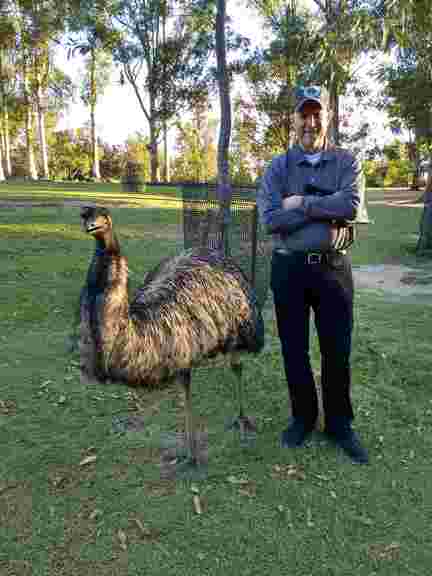
One of the things Australia is known for is their animals. The Tasmanian devil looks like a giant rat, and the wombat’s poop is square-shaped (that sounds painful). But of course, most people think of these Australian animals:

IMG_20180615_231225770_HDR

20180616_162325 (2)

IMG_1592

Neither the kangaroo nor the emu can walk backward, so Australia put them on its coat of arms to signify that the country is always looking forward. But Aussies are happy to eat their national animal and bird. And we joined right in, enjoying pizzas topped with both kangaroo and emu (as well as crocodile). And you can buy kangaroo and emu at almost any butcher shop.

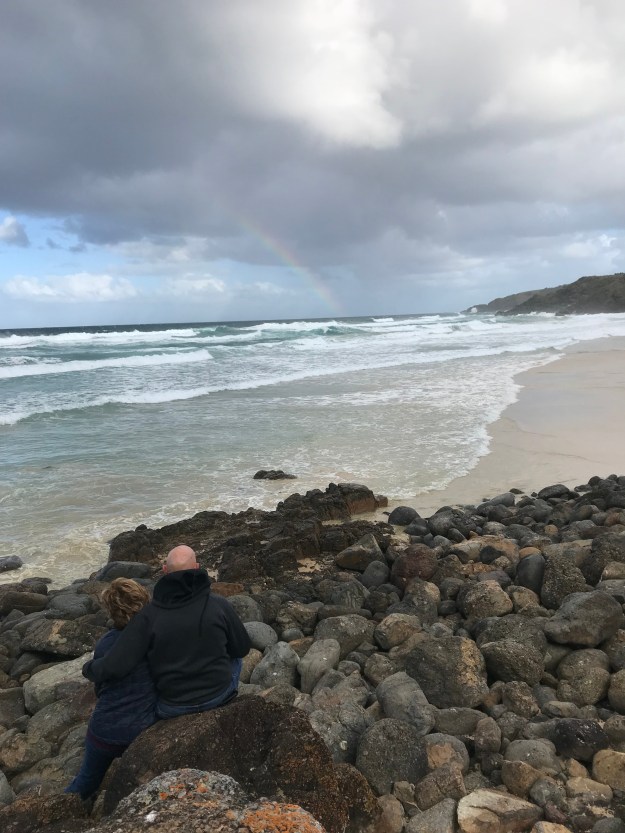
Similar to New Zealand, Australia has three times more sheep than people, and 25 percent of the population was born in another country. More than 80 percent of the people of Australia live within 70 miles of the coast. And a beautiful coast it is!

IMG_1657

If you visited a different beach in Australia once a day, it would take you 27 years to see them all. One of the beaches we visited was beautiful Byron Bay, next to Point Byron, which is the most easterly point of Australia. It has one of the most picturesque lighthouses anywhere:

20180619_161154 (2)

When I saw this lighthouse, I immediately thought of one of my favorite movies set in Australia, The Light Between Oceans.[ii] It is the story of a lighthouse keeper and his wife who rescue an infant from a boat off the coast of their lighthouse and raise her as their own. The rescuing of the child is especially poignant since they can’t have children of their own:

All is well until they discover the mother of the child is still alive. If they keep the child (and the secret of where she came from), no one would probably ever know the child is not theirs. But will their consciences let them? It is an interesting ethical and moral dilemma that I am glad I will never have to face.

Both Aussies and Kiwis are proud of their heritage and sense of justice, while at the same time acknowledging their indigenous peoples. I found it particularly interesting in Australia where tour guides always take a moment to recognize the heritage of their aboriginal people. Australia declared 1988 as a year of mourning for the Aborigines, and in 2007, Australia’s prime minister issued a national apology to their native people for the way the English and other immigrants treated them. In contrast, here in the States, how often do we respect or even acknowledge the cultural heritage of Native Americans?

New Zealand was the first country to grant the vote to women (1893); Australia was the second (1902). Australia was the first country to put in place an 8-hour work day. Both nations were our allies in World War I and World War II. Many of New Zealand’s and Australia’s troops fought together at the ill-fated battle Gallipoli in World War I. Fifty-eight percent of all New Zealand troops in World War I were casualties. For Australia, World War I was its costliest war in terms of deaths and casualties. From a population of fewer than five million at the time, 416,809 men enlisted, of whom more than 60,000 were killed and 156,000 wounded, gassed, or taken prisoner.  The film, Gallipoli,[iii] depicts young Australians joining the war for patriotism and adventure, but realizing all too soon the horror of war, often resulting from the mismanagement of their leaders. Here is the ending scene:

Probably my all-time favorite Australian movie is Breaker Morant.[iv] It is the tragic true story of three Australian lieutenants who are court-martialed for executing prisoners during the Boer War, even though they acted under the orders of their superiors. Using these junior officers as scapegoats, the General Staff of the military were trying to deflect attention from their own war crimes.  Here is the ending scene (it is a bit long but powerful):

(The epitaph from Matthew 10:36 in the clip is hard to understand. It reads “A man’s foes shall be of his own household.”)

Of all the things that impressed me about New Zealand and Australia, the most impressive was the friendliness of the people, who were always willing to chat and always willing to help us find our way around. And I loved their laidback attitude of just taking life as it comes. “No worries” is a common expression in both countries, and they take it to heart. If we, Americans, could learn one lesson from our Kiwi and Aussie friends, I hope it would be that.


[i] The World’s Fastest Indian

  • Production Companies: OLC/Rights Entertainment, Tanlay, New Zealand Film Production Fund
  • Director: Roger Donaldson
  • Screenwriter: Roger Donaldson
  • Starring: Anthony Hopkins and Diane Ladd
  • Release date: March 24, 2006

[ii] The Light Between Oceans

  • Production Companies: Heyday Films, LBO Productions (II), and Dreamworks
  • Director: Derek Cianfrance
  • Screenwriter: Derek Cianfrance (based on the novel by M.L. Stedman)
  • Starring: Michael Fassbender, Alicia Vikander, and Rachel Weisz
  • Release date: September 2, 2016

[iii] Gallipoli

  • Production Companies: Australian Film Commission and R&R Films
  • Director: Peter Weir
  • Screenwriter: David Williamson and Peter Weir
  • Starring: Mel Gibson and Mark Lee
  • Release date: August 28, 1981

[iv] Breaker Morant

  • Production Companies: South Australian Film Corporation and The Australian Film Commission
  • Director: Bruce Beresford
  • Screenwriters: Jonathan Hardy and David Stevens
  • Starring: Edward Woodward, Jack Thompson, and John Waters
  • Release date: July 3, 1980


It’s a Long, Long Road

Recently, I reached two milestones, both of which emphasized my age: my oldest grandchild graduated from high school, and I began my retirement. Milestones are funny. We look forward to them, focus on them, work hard to reach them, and then we do. We might celebrate them for a day or two, check them off our bucket list and then move on, focusing on our next milestone. At some point, though, we stop looking ahead to the next milestone and look back from where we came. And then when people ask us about our lives, what do we do? We recite our milestones: I was born, I graduated from high school, then college, and then graduate school. I got married, I had children, then grandchildren, I retired, and later I died. And we call that a life.

As I watched my grandson graduate, I reminded myself that he is starting a beautiful time of life. There will be new friends and lovers, exciting opportunities, a bright future ahead. I admit I was a bit envious of him, wishing, at least for a brief moment, that I had the chance to start over. Would I do things differently? Would I make the same mistakes all over again? Would I work harder or play harder?

That’s the great thing about reaching a milestone; it gives us a chance to stop and reflect and start anew, chasing new goals and experiencing new adventures. Sadly, as we reach one milestone, we immediately focus on the next one, without much reflection on the experiences along the way. We tell ourselves, life will be much easier, and therefore better, when the kids get a little older, or when I get through school, or when I get that next promotion.

Ann Landers once wrote, “At age 20, we worry about what others think of us. At age 40, we don’t care what others think of us. At age 60, we discover they haven’t been thinking of us at all.” That’s the problem with reaching retirement. It is the first milestone where we spend most of our time looking back, not forward, and most of us don’t like what we see. We remind ourselves of all our failures, and we think about the what ifs and if only this or that had happened. We analyze our lives and wonder if our life made any difference at all.

One of my favorite movies about retirement is About Schmidt.[i] I smile every time I watch the opening scene, where, on the day of Warren Schmidt’s retirement, he refuses to leave the office until 5 p.m. on the dot. (In contrast, I was out the door before 2 pm, and would have been gone much sooner except for a farewell lunch in my honor hosted by some very good friends.) Not surprisingly, Schmidt has a hard time adjusting to retirement. He returns to his workplace and offers to help out, but he is no longer needed. His wife suddenly dies, and soon he finds himself alone and lonely. One day, with nothing more exciting to do, while watching television he is touched by a commercial showing the poverty in Africa and decides to sponsor of a young boy for only $22 per month. As a sponsor, Schmidt is encouraged to write letters to his new foster child. At one point, Schmidt writes this depressing letter, that sadly many of can relate to:

But retirement can be an exciting time of life, too. Like any other milestone, it is an opportunity to make new friends, enjoy new experiences, and accomplish new things. We can take a risk, like the women in the fact-based film, Calendar Girls,[ii] where a group of retirement-aged women decide to pose nude for a calendar to raise money for the fight against leukemia. Enjoy this scene where many of the women take it all off (don’t worry, it’s rated PG-13):

Most people do not think an old codger like me has little to contribute to the world I left behind. But one thing us old folks can contribute is our experience, which might be the only thing most of us get out of life. Or as someone once said, “Experience is a wonderful thing. It enables you to recognize a mistake every time you repeat it.” I love this mentoring scene from The Best Exotic Marigold Hotel:[iii]

That scene also reminds us that the so-called Golden Years can be a time of loss. I continually hope my wife and I die on the very same day, but the odds of that are not in our favor. Almost invariably, one spouse dies before the other. But you are never too old to fall (or stay) in love, or even return to a love from the past:

Warren Schmidt gets an answer to his letter to his foster child that helps him realize what is truly important in life:

Sure, generations from now, few if anyone will remember us or what we did. But leaving a legacy long remembered is not what is most important in life. The way we make a difference in this world is not in the milestones we achieve, but with the connections we make along the way. It is the relationships we develop with family, with friends, with neighbors, with teachers, and sometimes even with total strangers. A smile, a kind or encouraging word, a helping hand – these are the things that make a difference in people’s lives.

Newspaper columnist Doug Larson said, “If people concentrated on the really important things in life, there’d be a shortage of fishing poles.” I agree with that, as long as we are fishing together.


[i] About Schmidt

  • Production Company: New Line Cinema and Avery Pix
  • Director: Alexander Payne
  • Screenwriter: Alexander Payne (from the novel by Louis Begley)
  • Starring: Jack Nicholson and Hope Davis
  • Release date: January 3, 2003

[ii] Calendar Girls

  • Production Company: Touchstone Pictures, Harbour Pictures, and Buena Vista International
  • Director: Nigel Cole
  • Screenwriters: Juliette Towhidi and Tim Firth
  • Starring: Helen Mirren, Julie Walters and Penelope Wilton
  • Release date: January 1, 2004

[iii] The Best Exotic Marigold Hotel

  • Production Company: Blueprint Pictures
  • Director: John Madden
  • Screenwriter: Ol Parker (from the novel by Deborah Moggach
  • Starring: Judi Dench, Bill Nighy and Maggie Smith
  • Release date: May 25, 2012


Criminal Injustice

One night, years ago, a friend called me, wanting some legal advice. It wasn’t for her, but for her neighbor. Her next door neighbor owned a motorcycle and had held his toddler on the bike between his legs and drove him around the driveway. Another neighbor, seeing this, called the police, who came and arrested the man for reckless endangerment of a child. Admittedly, it might not have been the smartest thing to do, but it wasn’t like the man was out on the highway traveling 60 miles per hour. I mean, how fast can you go turning laps in your driveway? A child probably has a more significant risk of danger by being tossed up in the air and caught by a parent. And who of us that are parents haven’t done that? Don’t the police have anything better to do?

On another occasion, I attended a sentencing hearing to read a letter I helped two brothers write. These brothers were the majority owners of the oil and gas company I worked for at the time. The person being sentenced was a former employee, who had embezzled about $200,000 from the company. She was no ordinary employee. She was one of the first employees hired and was very close to these two brothers, and even babysat their kids from time to time. The brothers were devastated by these events – not as much over the loss of the $200,000, but because of the violation of their trust in the woman. They knew there had to be an explanation for her actions. They figured she must have had gambling debts or she was paying for someone’s cancer treatments. But no explanation surfaced, and the woman, even when repeatedly asked by the FBI, prosecutors, and the judge, remained silent. The brothers were so angry at her that they didn’t want to see her ever again. Thus, they asked me to read their letter to the judge. The judge, apparently frustrated by her lack of forthrightness, stated he wanted to sentence her to more time, but sentencing guidelines restricted him from imposing more than a two-year sentence. The judge also imposed an order that she repay the debt. To my knowledge, though, not a single cent was ever repaid. So if the sentencing guidelines were just guidelines, why did the judge feel so compelled to follow them to the letter?

America’s judicial system has some serious problems. Recently I watched the film, Detroit.[i] It is a fact-based depiction of the race riots that took place there in 1967 and focuses on a few rogue police officers who killed three young black men and verbally and physically abused nine other people (seven black men and two white women) at a local motel. The police were searching for an alleged sniper and the gun he was using (which turned out to be a starter’s pistol, capable of shooting only blanks). Here is a scene illustrating the brutality and bigotry of the police officers. It is hard to watch because of the violence and the language, so skip it if you are faint of heart:

The state of Michigan later brought assault and murder charges against three of the officers involved. Despite the victims testifying of these officers’ actions in great detail, a jury composed of twelve white men acquitted all three.

As a lawyer, I should know something about the criminal justice system in America. Sadly, almost all of my knowledge comes from personal experiences with family and friends. Based on those experiences, I have learned three sorry truths about our criminal justice system: the punishment is often disproportionate to the wrongdoing, rarely is the mental health of the perpetrator considered in prosecution or punishment, and once you are in the system, it is tough to get out.

The documentary, 13th,[ii] looks closely at the criminal justice system in America, and leads one to the conclusion that it is racially biased. The title comes from the 13th Amendment to the Constitution, which outlaws slavery, but with one caveat: “except as a punishment for a crime whereof the party shall have been duly convicted.” The film argues that using this loophole, and the “law and order” and anti-drug policies of American Presidencies starting with Richard Nixon, people of color have continually been dominated and disenfranchised. Here is a clip:

Whether or not you believe the premise of 13th, both statistics and anecdotal accounts of our criminal justice system are startling.

In 1972, the prison population in America was 300,000. Now there are 2.3 million. The United States has the highest rate of incarceration in the world. Also, seven million people are on probation or parole. Unbelievably, one in three black men between the ages of 18 and 30 are in jail or on probation or parole. In large urban areas such as Los Angeles, Baltimore, and Washington, D.C., those percentages increase to between 50 and 60 percent. In Alabama, 34 percent of all black men have permanently lost the right to vote because of a conviction of a felony.

If you are thinking, well it’s good that all these felons are behind bars, making our streets safer for the rest of us, think again. Two-thirds of the people currently in jail are there while they wait for their day in court. In other words, they have not been convicted of their alleged crime and remain in prison because they have been either denied bail or they are too poor to pay it. Of the 12 million arrests in this country, only five percent of those are for violent crimes. Only five percent! The vast majority of arrests (about 75 percent) are for low-level misdemeanors (like my friend’s motorcycle-riding neighbor). If you think the system is always fair to all races and all economic classes, then consider the story of the homeless man in Texas who, on a cold night, stole four blankets to keep warm. He spent eight months in jail awaiting his trial because he had no means to pay the $3500 bail. Or the Louisiana man sentenced to 13 years in prison for possession of two marijuana joints. Or three teenage boys in West Memphis, tried as adults in 1994, for the murder of three young boys. One was sentenced to the death, and the other two to life imprisonment, primarily because they might have been involved in satanic ritual. The movie, Devil’s Knot,[iii] is a dramatization of the events surrounding these three teenagers.   Here is a trailer for the movie:

In 2007, new forensic evidence in their case revealed there was no DNA evidence at the scene or on the victims from the three defendants. The courts, however, disallowed this new evidence. Four years later, the defendants worked out a plea bargain with prosecutors. In the agreement, the defendants continued to assert their innocence but admitted there was sufficient evidence to convict them. For such an admission, the three defendants, now grown men, were released from prison for time served. Each served over 18 years in prison.

So what can be done to improve the system? Bryan Stevenson,[iv] an attorney who specializes in defending young boys who are being tried as adults, argues that race and wealth need to come out of the justice equation. He often asks the question, how does it happen that we allow judges to turn a young boy, maybe as young as 13, into something he is not (an adult)? He would like to turn that same young boy into a 70-year-old white CEO of a major company and see what justice looks like then. Or in his words, the opposite of poverty in America is not wealth; it’s justice. Anne Miligram,[v] the former Attorney General of New Jersey, through analyzing mountains of data, has developed a rating system which focuses on the odds of a defendant being a threat to public safety and being a repeat offender. She is striving to make sure that such a system is available to every judge in America so those judges can make informed decisions of whether a defendant is an actual risk to the public’s safety rather than relying entirely on a judge’s gut instinct. And Andrew Jolley, part of the ever-growing business around medical marijuana, urges that drug laws be amended so the punishment more accurately fits the crime. With mandatory sentencing for drug convictions, a mail courier, for example, would be sentenced to ten years in prison if he had two previous misdemeanor convictions and then found guilty of possession for carrying a package of drugs, even though he or she did not know the contents of the package.

Perhaps Andrew Jolley is right. We need to change our drug laws. John Ehrlichman, the Domestic Policy Advisor for Richard Nixon, explains the real intentions behind the War on Drugs, the results of which are still with us today:

“Do you want to know what this was really about? The Nixon campaign in 1968 and the Nixon Whitehouse after that had two enemies: the anti-war left, and black people. Do you understand what I’m saying? We knew we couldn’t make it illegal to either be against the [Vietnam] War or black, but by getting the public to associate the hippies with marijuana and the blacks with heroin, and then criminalizing both heavily, we could disrupt those communities. We could arrest their leaders, raid their homes, break up their meetings and vilify them night after night on the evening news. Did we know we were lying about the drugs? Of course, we did.”

Here are a few of my suggestions on how to start fixing our criminal justice system:

  1. Pay attention to and speak out against injustice, wherever you find it. The first step to any change is recognition of the problem.
  2. Focus more on compensating the victims of crime than punishing the criminal (although I believe that punishment is still an important part of the process).
  3. Require all states to pay adequate compensation to those who are convicted and later exonerated through DNA or other evidence. Sadly, one in nine prisoners sentenced to death has later been exonerated.
  4. Stop prosecutors from seeking the maximum crime with the maximum penalty, even though the evidence does not support such a charge, which often forces a defendant, even if innocent, to plead to a lesser crime rather than face the chance of being found guilty and serving the maximum sentence or even death. Effectively, this practice is denying many defendants the right to have their day in court.
  5. Change the mandatory sentencing laws for habitual crimes. Serving a life sentence for non-violent drug offenses, for example, far exceeds the nature of the crime.
  6. Set bail amounts based on whether the defendant is a risk to the public’s safety and a flight risk. Poor people, in jail for a non-violent crime but who cannot afford the bail, should have expedited arraignments and trials.
  7. Support public defenders and civil rights watch groups. These people are underpaid and overworked. Even small donations are greatly appreciated.
  8. Support programs that factor in and treat defendants suffering from mental illness. For many of these defendants, incarceration in prison is the last place they should be. Drug treatment facilities or mental health centers are a far better option, and those treatments might actually get at the root of the criminal behavior.
  9. Be careful of relying on eyewitness testimony alone. There are too many examples of witnesses misremembering that we should always require corroborating evidence.
  10. Legalize medical marijuana in all states. The medical benefits of marijuana for some illnesses and the relief of side effects from certain medical treatments are undisputed. It is crazy that people needing these benefits must either move or engage in criminal activity.

You may disagree with some or all of my suggestions, and that is okay. But we need to begin having serious discussions about this issue. Talk is always good. Action is better.


[i] Detroit

  • Production Company: Annapurna Pictures, First Light Production
  • Director: Kathryn Bigelow
  • Screenwriter: Mark Boal
  • Starring: John Boyega, Anthony Mackie, Algee Smith
  • Release date: August 4, 2017

[ii] 13th

  • Production Company: Kandoo Films
  • Director: Ava DuVernay
  • Screenwriters: Spencer Averick and Ava DuVernay
  • Starring: Melina Abdullah, Michelle Alexander, Cory Booker
  • Release date: October 7, 2016

[iii] Devil’s Knot

  • Production Company: Worldwide Entertainment
  • Director: Atom Egoyan
  • Screenwriters: Paul Harris Boardman and Scott Derrickson (based on the book by Mara Leveritt)
  • Starring: Colin Firth, Reese Witherspoon, Alessandro Nivola
  • Release date: March 12, 2013

[iv] Watch his Ted talk at https://www.ted.com/talks/bryan_stevenson_we_need_to_talk_about_an_injustice

[v] Watch her Ted talk at https://www.ted.com/talks/anne_milgram_why_smart_statistics_are_the_key_to_fighting_crime


Everyone Should Have a Spare

Bob Hope once said, “Aren’t mothers wonderful? Everyone should have a spare.” I have thought a lot about mothers lately. We just celebrated Mother’s Day. I had to speak in church on a mother’s worth. And I recently saw the movie, Tully,[i] about a woman trying to cope with the demands of motherhood. The movie illustrates the saying, to the mother of young children, there’s a time and place for everything – except rest. Because of a few twists in the film, I won’t tell you more, but if you haven’t seen it, I recommend you do. It is a movie every mother should see, as well as every father. And talk about it afterward. Here is a short scene from the movie:

But back to Bob Hope. I have debated with myself whether I believe his statement to be true. Would I really want a spare mother? Mine was a very involved parent – often too involved for my liking. She wanted to know everything about my life. “How was school today?” “Tell me about your friends.” And so on. As a teenager, I had to be home by 11 pm. If I wasn’t home by then, Mom started calling my friends to see where I was, which didn’t go over well with them, or their sleeping parents. At dinnertime, our menu was like comedian’s Buddy Hackett’s. We had two choices, take it or leave it. Mom forced me to go to church every Sunday, even when I didn’t want to go and even though I argued that forcing me to go was destroying my free agency. And her frugality often embarrassed me. When we went to a nice restaurant, which wasn’t very often, we went to the same seafood restaurant where all of us had to have the same thing – fish and chips – which, of course, was the cheapest thing on the menu. And Halloween was never that much fun for me, as Mom would never buy me a costume like the parents of most of the kids at school. I always had to wear homemade costumes, which were often hand-me-downs of costumes worn by my older brothers or sister. When I finally graduated from law school, I had two job offers, one in Salt Lake City, and one in Denver. I took the job in Denver partly to put some space between me and Mom (although I admit the job in Denver paying me almost double what the job in Salt Lake would pay was a major factor in my decision).

My family growing up was mostly normal, although we had our share of quirks. We were not like most families depicted in movies, which are generally dysfunctional (which adds to the drama). But occasionally, I find a film that has a mom I wish I had. Here are four of those movie supermoms:

Mrs. Gump: Who wouldn’t love a mother like Forrest’s in Forrest Gump?[ii] In her folksy way (“Life is like a box of chocolates…”), she instilled in Forrest a self-confidence that led him to believe he could (and he did) accomplish anything he put his mind to, despite being born with some physical and mental challenges.

Rusty Dennis: Mask[iii] is the true story of Rusty Dennis, a biker and mother of Rocky, a teenager with a massive facial skull deformity. But despite his deformity, Rocky is warm, sensitive, and intelligent. And his mom, Rusty, will not put up with anyone who fails to give Rocky the same respect and opportunities as anyone else. With his mother’s help and her badass attitude, Rocky is able to overcome pain, pity, and prejudice to become a role model for all of us.

Leigh Anne Tuohy: In another true story, The Blind Side,[iv] Leigh Anne Tuohy welcomes Michael Oher into her family’s home. Michael is a homeless teenager who has been in and out of foster care. He has a learning disability, but a large, athletic body. With the help of Leigh Anne Tuohy, Michael overcomes his upbringing, his learning disability, and goes on to become an All-American football player and help the Baltimore Ravens win the Super Bowl in 2013. Although not her real son (at least until she later adopted him), she provides him with every opportunity to succeed, from telling the high school football coach how to best use his skills, to hiring a tutor to help him improve his grades. I especially like this scene where she places Michael ahead of her relationship with the local society wives.

Helen Parr (a/k/a Elastigirl): Who wouldn’t want a superhero for a mother? Helen Parr, from the movie, The Incredibles,[v] and her family are undercover superheroes. All she wants for her children is for them to live normal, happy lives. But when danger calls, this mom will stop at nothing to protect her children.

The more I think about, the more I realize that, like Mrs. Gump, my mom taught me some great life lessons and instilled in me a system of values and a self-image that led me to believe I could accomplish great things. Fortunately, I was not born with a deformity like Rocky Dennis, but no one was a better nurse or more caring when I was sick or hurt than my mom. Mom, like Rusty Dennis (although not quite so badass), would not let anyone push her around when it came to her family. We did not enjoy the same economic status as the Tuohy family, but like Leigh Anne Tuohy, regardless of background, social status, or the number of digits in your bank account, family always came first. And Mom did everything she could to make sure I had all the opportunities I would need to succeed. Admittedly, Mom was not a superhero, but just like Helen Parr, there is nothing my mom wouldn’t do to protect her family.

Maybe Mom was not so sorry after all. Robert Browning once said, “Motherhood: All love begins and ends there.” My mom had her share of quirks that often annoyed me, especially while growing up, but she was the perfect example of what Browning was talking about. When she asked me a million questions about my day, my friends and my thoughts and fears, she was telling me that she cared about me as a person. When Mom wanted me home by 11 pm and called my friends when I wasn’t, she was telling me that she cared about my safety – and taught me responsibility at the same time. Although my mom was not all that generous when it came to fancy restaurants and Halloween costumes, she never shortchanged me when it came to providing a roof over my head, home-cooked meals, visits to the doctor when needed, and educational opportunities.

As I graduated from high school, we went to our favorite seafood restaurant again. As the waitress worked her way around the table, all my family ordered fish and chips. When she came to me, I looked at my mom and asked, “Why do we always order fish and chips?” Mom replied, “You can order anything you want. You always could. I just happen to like fish and chips.” When she said it, I felt like she was being like what Tenneva Jordan said about mothers: “A mother is a person who, seeing there are only four pieces of pie for five people, promptly announces she never did care for pie.” I ordered shrimp creole anyway.

After that day, during my college days, Mom and I would often eat lunch together, and she let me pick the restaurant. Those were some of the most enjoyable times I spent with her – not because of the food, but because of the one-on-one time we shared together. And I began to realize, that, while only five feet tall, Mom was a giant of a woman because of the size of her heart.

None of our mothers are perfect, including mine. I agree with Sydney J. Harris, who said, “The commonest fallacy among women is that simply having children makes one a mother—which is as absurd as believing that having a piano makes one a musician.” Fortunately for me, Mom become a mother – and a good one at that.

I am grateful that I had a mother that loved me unconditionally. Looking back, everything Mom did that annoyed me growing up, she did because of her love for me. And we can never get too much of that. So perhaps Bob Hope was right. We could all use a double dose of a mother’s love.

William Ross Wallace said, “The hand that rocks the cradle rules the world.” Thanks, Mom, for rocking my world. I am grateful for everything you did for me, but especially for your love. I only wish I had the chance to tell you that again.


[i] Tully

  • Production Company: Bron Studios, Right Way Productions, Denver and Delilah Productions
  • Director: Jason Reitman
  • Screenwriter: Diablo Cody
  • Starring: Charlize Theron, Mackenzie Davis, Mark Duplass
  • Release date: May 4, 2018

[ii] Forrest Gump

  • Production Company: Paramount Pictures
  • Director: Robert Zemeckis
  • Screenwriter: Eric Roth (based on the novel by Winston Groom)
  • Starring: Tom Hanks, Robin Wright, Gary Sinise
  • Release date: July 6, 1994

[iii] Mask

  • Production Company: Universal Pictures
  • Director: Peter Bogdanovich
  • Screenwriter: Anna Hamilton Phelan
  • Starring: Cher, Eric Stoltz, Sam Elliott
  • Release date: March 22, 1985

[iv] The Blind Side

  • Production Company: Alcon Entertainment, Left Tackle Pictures, Netter Productions
  • Director: John Lee Hancock
  • Screenwriter: John Lee Hancock (based on the book by Michael Lewis)
  • Starring: Sandra Bullock, Quinton Aaron, Tim McGraw
  • Release date: November 20, 2009

[v] The Incredibles

  • Production Company: Disney
  • Director: Brad Bird
  • Screenwriter: Brad Bird
  • Starring: Craig T. Nelson, Samuel L. Jackson, Holly Hunter
  • Release date: November 5, 2004


Fingered

I recently watched an episode of TV’s Dateline where members of the U.S. Olympic Gymnastics team discussed the sexual abuse they suffered at the hand (pun intended) of team doctor Larry Nassar. Ultimately, almost 200 victims testified that Dr. Nassar “fingered” their genitals under the guise of medical treatment. Dr. Nassar ultimately pled guilty to sexual assault charges dating as far back as 1997. Amazingly, more than 20 of the victims said there was a parent in the room during the abuse. How could such a thing happen and go on for so long? Gymnast Aly Raisman gives one explanation: “He does touch me, and I know he touches some of my teammates inappropriately, but he tells us that it will heal certain parts of our bodies, so we think that it’s okay.” Jessica Howard, who was the U.S. national champion in rhythmic gymnastics from 1999 to 2001, adds, “He started massaging me. And he had asked me not to wear any underwear. And then he just continued to go into more and more intimate places. I remember thinking something was off, but I didn’t feel like I was able to say anything because he was, you know, this very high profile doctor.”

Although minors, like these gymnasts, are the most vulnerable, all of us, at any age, are not immune from being deceived, especially by those in authority and by those we trust. Magician and escape artist James “The Amazing” Randi, in the documentary, An Honest Liar,[i] summed it up this way: “I know how to deceive people, and I know how to recognize when people are being deceived. I can cheat you countless different ways, and you won’t know, you won’t catch me…. Don’t be too sure of yourself. No matter how smart or well educated you are, you can be deceived.”

As captured in An Honest Liar, Randi spent the first half of his life entertaining people with his tricks and escapes, and the last half of his life exposing frauds who, for their own monetary gain, took advantage of people who trusted them. Here is the trailer for the documentary. It can be found on Netflix and is worth your time to watch it:

To me, the most frightening part of the documentary is when Randi exposed televangelist Peter Popoff’s faith healings as a fraud, but his victims didn’t seem to care. Randi and his investigator discovered that Popoff got his “revelations” not from God but from his wife (she spoke to him through an earpiece Popoff wore, providing him information that his “victims” had put on prayer cards before the show). These disclosures led many TV stations to drop Popoff’s show, eventually forcing him into bankruptcy. But Popoff rebounded by making faith-healing infomercials. These informercials reportedly brought in donations of more than $23 million in 2005 alone from viewers sending in money for promised healings and prosperity.

My profession is one that deals with gray areas when it comes to deciphering truth from deception. Before witnesses can testify in a lawsuit, generally speaking, they must experience what they intend to testify about. Witnesses must see it, hear it, feel it, taste it, or smell it. They cannot rely on the experiences of others; that’s called hearsay. But evidence, even that which we physically experience, is almost never pure and undefiled. We filter it through our biases, experiences, physical limitations, culture and beliefs. One of my favorite illustrations of this is the classic story about the blind men who, after feeling different parts of an elephant, try to describe what an elephant is. Each witness is right, as far as his limited experience goes, but each is also dead wrong considering the elephant as a whole.

My family lived in Austin, Texas, for about seven years and Lance Armstrong was not only the local hero but the nation’s hero. He overcame cancer to win biking’s most prestige race, the Tour de France, not once but seven times. I even wore one of this “Live Strong” wristbands for years.

When a teammate alleged he was doping, few of us could believe our hero was a cheater. Here is a scene from The Program,[ii] which sums things up well how so many of us responded when we first heard the allegations of Armstrong’s deception:

In addition to letting our personal filters color how we see and remember things, we can deceive ourselves merely by how our brains work. When it comes to our experiences, the human mind tries to do two things. First, it fills in the gaps. We want to know how a person or a situation got from Point A to Point B. If we don’t know, our brains make something up. And we consciously don’t even recognize this fabrication. Second, we try to make sense of things. We want to be able to say that everything happens for a reason, whether it does or not.

Elizabeth Loftus[iii] is a psychologist who specializes in false memories or how we can deceive ourselves into believing something that didn’t happen. She tells the true story of Steve Titus who police arrested for the rape of a female hitchhiker. The arrest came following a report that Titus’s car “looked something like the car the rapist was driving.” Upon his arrest, police took a photo of Titus and put it in a photo line-up with those of other men. The victim pointed to Titus and said, “That one’s the closest.” But by the time the trial came around, the victim testified that “I’m absolutely positive that’s the man.” How did the victim’s memory change from he’s the closest to absolutely sure? Perhaps the suggestions of the prosecutor or law enforcement changed or at least influenced her memory. Perhaps her mind, working alone to find certainty, convinced herself of Titus’s guilt. In any event, based on her testimony, and despite his credible alibi, the jury convicted Titus of the rape. Subsequent events led an investigative journalist to the real rapist, who ultimately confessed. Police also tied him to at least 50 other rapes in the area. Loftus, who worked on the Titus case, explains that we often allow suggestions to create a false memory, which we ultimately adopt as the truth. Studies back up Loftus’s statements. In one study of 300 people convicted of crimes that DNA evidence later proved they did not commit, at least 75 percent of those convictions were due to faulty eyewitness memories.

In short, Loftus believes, when you feed people misinformation about an experience they had, whether stressful or not, you can distort or even change their memories. She concludes, “Just because somebody tells you something and they say it with confidence, just because they say it with lots of detail, just because they express emotion when they say it, it doesn’t mean it really happened.”

Often, people or institutions we trust intentionally feed us misleading or false information to retain their preeminent position with us. A political consultant calls this spin. Psychologists refer to this technique as gaslighting. Technically, gaslighting is a form of mental abuse where information is twisted, spun or omitted, or false information is presented, with the intent of making victims doubt their memory or perception, or even their sanity. The term comes from the 1938 stage play, Gaslight, which was adapted as a movie in 1940, and again in 1944. In the film, a husband murders his wealthy Aunt twenty years previously and hides it from his wife by convincing her she is going insane through his manipulation of her memory. This scene from the 1940 version of Gaslight[iv] will give you the idea:

So what happens when we see or hear something that doesn’t fit into our current understanding of the truth? If it is a single event, we often consider it an aberration and dismiss it, or at least set it aside. But if we keep getting those same or similar messages, we often then change the narrative so our brains believe the altered memory is what happened all along. And if we take the use of these false memories to their logical conclusion, the result is mind control to the point where we can turn loyal soldiers into assassins of even their fellow soldiers, without remorse and perhaps even without any recollection that such atrocities occurred, as illustrated by this scene from the remake of The Manchurian Candidate:[v]

Someone once said, “If you succeed in cheating someone, don’t think that the person is a fool. Realize that the person trusted you much more than you deserved.” I hope we don’t find pleasure in deceiving anyone, especially if we are in a position of trust to the person we have taken advantage of. In many ways, we would be no different than Dr. Nassar taking advantage of Aly Raisman, Jessica Howard, or any of his other numerous victims. But as important, we need to constantly guard ourselves against harmful false memories, deception and the abuse of gaslighting.  And remember someone’s definition of stupid: Knowing the truth, seeing the truth, but still believing the lies.”


[i] An Honest Liar

  • Production Company: Left Turn Films, Pure Mutt Productions, and BBC Storyville
  • Directors: Tyler Measom and Justin Weinstein
  • Screenwriter: Tyler Measom and Greg O’Toole
  • Starring: James Randi, Deyvi Pena, and Penn Jillette
  • Release date: November 2, 2014

[ii] The Program

  • Production Company: Anton Capital Entertainment, StudioCanal, and Working Title Films
  • Director: Stephen Frears
  • Screenwriter: John Hodge (based on the book by David Walsh
  • Starring: Ben Foster, Chris O’Dowd, and Jesse Plemons
  • Release date: March 18, 2016

[iii] Watch Elizabeth Loftus’ Ted Talk at https://www.youtube.com/watch?v=PB2OegI6wvI

[iv] Gaslight

  • Production Company: British National Films
  • Director: Therold Dickinson
  • Screenwriter: A.R. Rawlinson (based on the stage play by Patrick Hamilton)
  • Starring: Anton Walbrook and Diana Wynyard
  • Release date: June 25, 1940 (UK), November 10, 1952 (USA)

[v] The Manchurian Candidate

  • Production Company: Paramount Pictures, Scott Rudin Productions, Clinica Estetico
  • Director: Jonathan Demme
  • Screenwriter: George Axelrod (based on the novel by Richard Condon)
  • Starring: Denzel Washington, Live Schreiber, and Meryl Streep
  • Release date: 2004


Some Gave All

I am a protester. Recently I got off my butt, hopped on a plane and participated in a protest march. I hadn’t done anything like that since 1971 when I took a break from college classwork, and with others, disrupted Vice President Spiro Agnew’s speech outside the Utah state capitol building. We were protesting the Vietnam War back then.

My latest protest took place on Good Friday, again in Salt Lake City. This time, I was protesting the LDS (Mormon) church’s policy regarding one-on-one interviews with youth. In addition to the potential danger of sexual harassment and abuse when a young person meets alone with someone in authority, often in these interviews, the church leader asks the youth probing questions of a sexual nature in an effort to determine the youth’s worthiness and adherence to Mormonism’s strict standards. Some have criticized the marchers for criticizing the church, but, as my wife says, most of my fellow marchers, like me, were not bitter toward the church, we only want to make the church better. The Boy Scouts and other churches have made significant changes in the ways they protect their youth against sexual predators; it’s time for the Mormon Church to do the same. And it would protect the church leader against unfounded claims of sexual abuse as well.

Was the march successful? Depending on who did the counting, there were anywhere from 800 to 2200 marchers. We marched while carrying signs from the Salt Lake City and County Building to the LDS Church’s headquarters, where we delivered books to church leaders containing over 500 stories of both physical and emotional abuse and shame behind closed doors with a church leader. Isn’t one story one too many? Because of the march (although they would probably not admit it), the church issued a new policy allowing the option of having another adult in the interview room with the youth and church leader. The policy also admonished all church leaders to take any claim of sexual abuse seriously, as more often than not, allegations of such abuse are based on fact. We didn’t get everything we wanted, but it was a baby step in the right direction.

But I didn’t want this entire post to be just about one-on-one church interviews. What surprised me most about the march was how good I felt afterward. I had stood up for something I believed in, and worked toward making actual change happen. One of my fellow marchers had brought their children to participate and told us how excited their kids were to come. “Sort of like Martin Luther King,” was the response of one of the children, which made me think of this scene from Selma:[i]

Not too long ago on this blog, I wrote another post about protesting (see https://lifelessonsthroughfilm.com/2017/10/14/take-a-knee/). That post focused on some things each of us could do to bring about change for the better. I dedicate this post to real-life heroes who were willing to give (and often gave) their lives for something they believed in, as illustrated in three of my all-time favorite fact-based movies. As you watch these clips, I hope you feel that same rush of adrenaline I feel every time I watch these movies, and that same rush I felt during the march for the children.

William Wallace lived in the late 1200s and became one of the leaders of Scotland during the Wars of Scottish Independence. In 1305, he was captured, handed over to King Edward I of England, and hanged and quartered for treason. In response to the treason charges, as a lover and fighter for freedom, Wallace said, “I could not be a traitor to Edward, for I was never his subject.” Here is one of my favorite scenes from Braveheart:[ii]

The 54th Massachusetts Infantry Regiment was the first all – African-American regiment to fight for the Union in the American Civil War (sadly, all their officers were white). During their training, the Confederates issued a proclamation which directly affected their future, as captured in this scene from Glory:[iii]

During its service, the 54th Massachusetts took part in the Battle of Grimball’s Landing and the more famous Second Battle of Fort Wagner, located just outside of Charleston, South Carolina. These soldiers carried out a frontal assault against the heavily armed fortress. Roughly 40 percent of the regiment were killed, wounded or went missing in that battle.

It is never easy to put your life on the line for something you believe in, but it can be a bit easier when you have like-minded men and women around you who share your cause. But Desmond Doss had no one.  As a conscientious objector, he served as a combat medic with an infantry unit during World War II. Doss twice received Bronze Star Medals for his work to save lives in Guam and the Philippines and became the only conscientious objector to win the Medal of Honor for saving 75 men during the Battle of Okinawa. Even though he could have received a military deferment for working in the shipyard at Newport News, Virginia, at the beginning of the war, he enlisted, but under the conditions that he would not have to kill enemy soldiers or even carry a gun. This commitment did not make him the most popular soldier in his unit, as depicted in this scene from Hacksaw Ridge:[iv]

Doss had to go through a military court before being allowed to stay in the army under his conditions as a conscientious objector. During the Battle of Okinawa, he was wounded four times, including fracturing his left arm and receiving 17 pieces of shrapnel throughout his body. Although initially considered a coward by his fellow soldiers for refusing to carry a gun, he ultimately proved he might have been the bravest of them all.

I believe these words of Martin Luther King: “He who passively accepts evil is as much involved with it as he who perpetrates it.” So stand up for something you believe in. And take courage from others who have done the same.


[i] Selma

  • Production Company: Pathé, Harpo Films, Plan B Entertainment
  • Director: Ava DuVernay
  • Screenwriter: Paul Webb
  • Starring: David Oyelowo, Carmen Ejogo, and Tim Roth
  • Release date: January 9, 2015

 [ii] Braveheart

  • Production Company: Icon Entertainment International, Ladd Company
  • Director: Mel Gibson
  • Screenwriter: Randall Wallace
  • Starring: Mel Gibson, Sophie Marceau, Patrick McGoohan
  • Release date: May 24, 1995

[iii] Glory

  • Production Company: TriStar Pictures, Freddie Fields Productions
  • Director: Edward Zwick
  • Screenwriter: Kevin Jarre (based on the book by Lincoln Kirstein)
  • Starring: Matthew Broderick, Denzel Washington, Cary Elwes
  • Release date: February 16, 1990

 [iv] Hacksaw Ridge

  • Production Company: Cross Creek Pictures, Demarest Films, Pandemonium
  • Director: Mel Gibson
  • Screenwriter: Robert Schenkkan and Andrew Knight
  • Starring: Andrew Garfield, Sam Worthington, Luke Bracey
  • Release date: November 4, 2016


Shades of Gray

For those of you who read the title of this post and were hoping I was going to discuss the sexually explicit movie, 50 Shades of Grey and its sequels, get your minds out of the gutter. But if you are one of those, does thinking about sex make you a bad person?

I recently attended one of my favorite musicals, Jekyll & Hyde,[i] based on Robert Louis Stevenson’s novel. The prologue to the musical starts out: “In each of us, there are two natures. If this primitive duality of man – good and evil – could be housed in separate identities, life would be relieved of all that is unbearable. It is the curse of mankind that these polar twins should be constantly struggling.” Dr. Jekyll then tries to separate the good from the evil inside him, but not with the results he was hoping for.

For most of us, it’s not that we are good or evil; we are good and evil. In my younger days, parents and teachers taught me that figuratively the spirit of Christ whispered in my one ear, urging me to do what is right, while Satan whispered in my other ear, telling me to do evil. All I had to do was listen to the right voice. I now realize life is not so simple. I like to think I am a good person. I try to relate to this scene from Groundhog Day:[ii]

Despite Christ’s commandment in his Sermon on the Mount that we should be perfect, none of us are. Sadly, it seems, as we improve one area of our lives, we might get worse in another. For example, no one doubts Steve Jobs was a brilliant developer of computer technology, but, as illustrated in Steve Jobs,[iii] perhaps he was not that great of a parent:

How do our motivations factor in? Who is more evil, the man in Split who is diagnosed with 23 separate personalities and kidnaps three girls, or the couple in The Light Between Oceans, who raise a baby as their own they rescued from a drifting rowboat even though they know the mother is alive and searching for the child? Few, if any of us, always do the right thing and for the right reasons.

But who is to say what is right and what is wrong? We shouldn’t confuse perfection with everyone believing and acting the same. If you believe in gun-control, are you un-American and therefore evil? Does the belief that abortion is murder make you a good person? Depending on whether you believe an LGBTQ person is that way due to choice or biology may determine whether, to you, that person is evil or just being themselves.

One of my all-time favorite movies is Pleasantville.[iv] Although the film lends meaning to various aspects of our lives, one thing it taught me was that “perfection” – where everyone thinks the same, acts the same, and avoids certain places that are considered evil – can be, well, boring. You might remember the opening scenes where everything is perfect. Even the local high school basketball team was perfect, never missing a shot, until one day in practice, the star of the team gets angry, and this happens:

Don’t you love how the team avoids getting even near the basketball as if it had suddenly turned evil because it rimmed out? The basketball, of course, is incapable of doing evil by itself, but the players determined it was evil by placing their own values upon it. Do we ever do that to the people around us? Of course, we don’t. That would be evil. (You do recognize sarcasm when you hear it, right?)

As depicted in Pleasantville, it’s our differences that give us color. It’s different points of view, different beliefs, and different experiences that give our lives richness, and makes us unique. Actor and former NFL football player, Terry Crews, said it this way: “The thing that you think is imperfect about you is the thing that makes you who you are. It separates you from everybody else.” It is sad, then, in this second clip from Pleasantville, that Betty Parker feels like she must cover up what has now made her different from everyone else:

Please don’t misunderstand me. There is evil in the world. Fortunately, most of us intuitively know when we are doing the right (or wrong) thing. But that does not mean we all have to be the same. And when we try to impose our values on others, are we being good or evil?

One of my favorite movies of the past year is Hostiles,[v] which, unfortunately, few people saw. The movie is set in the western United States in 1892. A decorated Army captain, Joseph Blocker, a veteran of the Indian wars for two decades, is commanded to escort a dying Cheyenne chief, Yellow Hawk, with his family to their Montana ancestral homeland. The problem is, the chief is the captain’s most hated enemy. To each of these long-time combatants, the other is evil personified. Here is what Captain Blocker says about the chief and his tribe at the beginning of the trek: “What happened before, when Yellow Hawk and his dog-soldiers got a hold of them, there wasn’t enough left of those poor men to fill a slop pail. Understand? When we lay our heads down at night out here, we’re all prisoners. I hate him. I’ve got a warbag of reasons to hate him.”

But something interesting occurs along the road to Montana. Captain Blocker ultimately sees Chief Yellow Hawk as a person with a family, with traditions and values, who has spent his life protecting that family, preserving those values, and defending his homeland. In the end, Captain Blocker realizes Chief Yellow Hawk is maybe not quite as evil as he once considered him to be. The history of wars would be written much differently if it was written by the conquered, rather than the victorious.

Like Captain Blocker, when we get to know and understand others, we might be surprised to find that those we think of as evil because they have different perspectives than we do are not evil at all. I close with these beautiful words from the song, Rocks, by Angela Soffe:[vi]

  • I don’t know much about anything
  • But I know something is tearing me down
  • I wake up thinking about all the ways I don’t measure up
  • And it hurts to let them down
  • So judge me, cast me your stones
  • I will lay them back at your feet
  • Take my hand, let’s walk a mile
  • We like to throw rocks at the people who don’t see the world in the way we do
  • I don’t know why we all stand in a circle and point a finger or two
  • Tell me how can you see what is buried beneath a mountain of smiles?
  • We’re all thrown in the same blue water of the unknown
  • So leave your rocks at home

Let’s use our rocks to build up, not tear down, knowing there is some good and some bad in all of us.


[i] Music by Frank Wildhorn, book by Leslie Bricusse, and lyrics by Frank Wildhorn, Leslie Bricusse, and Steve Cuden

[ii] Groundhog Day

  • Production Company: Columbia Pictures Corporation
  • Director: Harold Ramis
  • Screenwriters: Danny Rubin and Harold Ramis
  • Starring: Bill Murray, Andie MacDowell, and Chris Elliott
  • Release date: February 12, 1993

[iii] Steve Jobs

  • Production Company: Universal Pictures, Legendary Entertainment, Scott Rudin Productions
  • Director: Danny Boyle
  • Screenwriter: Aaron Sorkin (based on the book by Walter Isaacson)
  • Starring: Michael Fassbender, Kate Winslet, and Seth Rogen
  • Release date: October 23, 2015

[iv] Pleasantville

  • Production Company: New Line Cinema, Larger Than Life Productions
  • Director: Gary Ross
  • Screenwriter: Gary Ross
  • Starring: Toby Maguire, Jeff Daniels, Joan Allen
  • Release date: October 23, 1998

[v] Hostiles

  • Production Company: Grisbi Productions, Le, Waypoint Entertainment
  • Director: Scott Cooper
  • Screenwriter: Scott Cooper (based on the manuscript by Donald E. Stewart)
  • Starring: Christian Bale, Rosamund Pike, Scott Shepherd
  • Release date: January 26, 2018

[vi] Visit https://www.angelasoffe.com/


Doing it Backward

It was once said of Ginger Rogers, the frequent partner of dance legend, Fred Astaire, “Sure he was great, but don’t forget that Ginger Rogers did everything he did, … backward and in high heels.” Yes, women are wonderful, but sometimes they can be hard to understand for us men. Sigmund Freud might have summed it up best when he said, “After thirty years of research into the feminine soul, the great question which I haven’t been able to answer is: What does a woman want?” In honor of March being Women’s History Month, this blog post will be my feeble attempt to at least partially answer that question.

To me, there is nothing sexier than a strong woman – one who can think for herself and who stands up for what she believes in. I that regard, I have been fortunate to love several sexy women (although some only as good friends). My mother was a strong woman (although I’m not so much of a sicko as to consider her sexy). I credit her with instilling in me a system of values and a self-image that led me to believe I could accomplish great things. My wife is as sexy as they come and has taught me many things, not the least of which is to love, respect and defend anyone and everyone who might be different from most of us. I fear I am still way behind her in that. And I have had the privilege of working with many smart, talented women who taught me you don’t have to be a man to succeed. I credit one of those women as the inspiration behind my writing efforts.

So how is it that women have had to fight so hard to be recognized as equal to men? For centuries, women have been considered not much more than the property of a man. Maybe we can blame a wrong interpretation of the Bible for that. Most people picture Eve of the Garden of Eden as either weak-willed in connection with God’s commandments, or worse, downright evil. But I imagine Eve differently. I see her as an equal partner in the creation of humankind. Part of the negative stereotype of Eve comes from Genesis calling her a “help meet” for Adam, which we often misunderstand as being synonymous with a servant. But the dictionary defines “help meet” in part as “even with or equal to.” The English words translated from the original Hebrew go even further. Those words mean “equal” and “to be strong,” as a “savior.”

So what do women want? Let’s start with the basics. Women want the same rights as men. I find it incomprehensible that women were not granted the fundamental right to vote until 1920 in the United States. This change in the Constitution happened so recently my mother experienced it. And the struggle was not easy. Here is a clip from the movie Suffragette[i] that illustrates the struggle to secure this basic right in Great Britain:

Again, it is remarkable that only in the last century we changed the laws so women could vote and own property, and even more recently, made pregnancy a medical condition deserving of health care coverage.

Women don’t necessarily want advantages over men. They just want the same opportunities enjoyed by men for years. Although admittedly more about racial discrimination than gender bias, I love this scene from Hidden Figures[ii]:

The title of the movie says it all. Why have we kept so many intelligent, talented women hidden for so long?

Poet and civil rights activist, Maya Angelou, said, “People will forget what you said, people will forget what you did, but people will never forget how you made them feel.” Laws have finally started to catch up with the injustices we have heaped on women for centuries, but many of us men still need to change how we make women feel. And what do women want to feel? As someone of worth, of value, as our equals. Sadly, as men, we often think we treat women as our equals, but as the author, Carol Lynn Pearson, points out, “We may say we value women, but what we mean is we love their service, we want their sacrifice. We don’t want their wholeness and their perspectives and their humanity. … Being treated with politeness, consideration, even respect is different from being treated as an equal.” I recommend watching a great little movie out of Great Britain that illustrates Pearson’s point. Made in Dagenham[iii] is the true story of the 1968 strike at the Ford Motor Company at Dagenham (a suburb of London) where women workers walked off the job in protest over discrimination in wages:

Joseph Conrad acknowledged that “Being a woman is a terribly difficult task since it consists principally in dealing with men.” Men, let’s make that task easier for the women we love. Let’s make sure we truly value them as equals.  Sadly, for many of us, that might require a paradigm shift in our basic attitudes toward women. Carol Lynn Pearson describes that paradigm shift as follows:

“Long ago, humanity shifted scientific theory from … the earth at the center of the solar system to … the sun at the center of the solar system. I yearn for the paradigm shift that moves the male-female relationship theory from the patriarchal system (the male at the center of the universe with female orbiting around him) to the partnership system (male and female dancing in perfect balance at the center of the universe). No one is personally harmed by the fiction that the earth is the center point of everything, but this other fiction – the fiction that maleness is central and femaleness auxiliary – this affects the daily life of every woman and every man that it touches and leaves us disoriented, many of us displaced and disheartened, and some of us seriously abused.”

So men, the next time a strong, intelligent woman speaks to you, really listen to and value her opinion. And let’s adopt as our new credo the words of author Virginia Woolf: “Men and women are different. What needs to be made equal is the value placed on those differences.”


[i] Suffragette

  • Production Company: Ruby Films, Pathé, and Film4
  • Director: Sarah Gavron
  • Screenwriter: Abi Morgan
  • Starring: Carey Mulligan, Anne-Marie Duff, Helena Bonham Carter
  • Release date: October 12, 2015

[ii] Hidden Figures

  • Production Company: Fox 2000, Chermin Entertainment, Levantine Films
  • Director: Theodore Melfi
  • Screenwriter: Allison Schroeder and Theodore Melfi
  • Starring: Taraji P. Henson, Octavia Spencer, Janelle Monáe
  • Release date: January 6, 2017

[iii] Made in Dagenham

  • Production Company: Audley Films, BBC Films, BMS Finance
  • Director: Nigel Cole
  • Screenwriter: William Ivory
  • Starring: Sally Hawkins, Bob Hoskins, Andrea Riseborough
  • Release date: September 20, 2010


You Big Cry Baby!

Growing up I had brief thoughts about pursuing a career in the entertainment industry either as a stand-up comedian or maybe even as an actor (you can stop laughing now). But I realized quickly I had no real talent and no great looks (which might be much more important than talent). I noticed that one thing great actors could do was cry on command. I don’t mean over-dramatic fake sobs, but letting loose with real tears. I could never do that. Once, during a sad situation with a former girlfriend (at least sad for me), I realized crying would be the right thing to do (or at least the dramatic thing to do). And finally, after about ten minutes of trying, I got a few tears to flow.

But the older I get, the more I find myself crying all the time – not so much the uncontrollable, ugly kind of cry, but I tear up constantly. I cry in movies. I cry reading books. I cry watching the news. I cry listening to music. And sometimes I cry just thinking about life in general. Perhaps, as I have gotten older, I have realized more and more that life isn’t fair, that bad things happen to good people, that the world is full of suffering. Maybe I have finally learned some empathy for others. I cry even more when I see ordinary people (or sometimes less than ordinary people) overcome adversity, stand up for the oppressed, or, being an underdog, beat the odds.

Now when I go to a movie, I tear up more often than not, regardless of whether the movie is supposed to be happy or sad. One of my worst movie-crying episodes came after watching The Perks of Being a Wallflower.[i] My nerves were raw due to dealing with circumstances involving a person I deeply cared about that were largely beyond his control and mine. I felt an overwhelming sadness and helplessness. When the tears started to roll, I couldn’t help myself, and the trickles turned into rivers of tears. Like Charlie in this clip, I couldn’t stop crying:

And that’s OK. Crying is actually good for us. Stephen Sideroff, Ph.D., a clinical psychologist at UCLA and director of the Raoul Wallenberg Institute of Ethics, says, “Crying activates the body in a healthy way. Letting down one’s guard and one’s defenses and [crying] is a very positive, healthy thing.” William Frey II, a biochemist at the St Paul-Ramsey Medical Center in Minneapolis, has found that emotional tears contain an endorphin that helps relieve pain, and hormones that help relieve stress. A study performed at the University of Florida revealed that crying improved the mood of almost 90 percent of those studied, with less than 9 percent reporting that crying made them feel worse. The fictional character, Lemony Snicket, said it this way: “A good, long session of weeping can often make you feel better, even if your circumstances have not changed one bit.”

Death of a loved one brings out the tears in most of us. As Shakespeare said, “To weep is to make less the depth of grief.” When I was twelve, my sister died. She was just 17. I remember that experience as if it happened only yesterday, and it brought about one of my first ugly cries. I heard of my sister’s death from my older brother who had picked me up from baseball practice. I was in shock until I got home. When I saw the many friends and family already there, some in tears, but everyone with sad faces, I gave my mother a hug and started crying uncontrollably, not so much for my sister – I knew she was in a good place – but mostly for my mom losing her only daughter, and for my other brother, who was out-of-town and would not be coming home for the funeral. Some similar feelings came to me when I finished reading The Fault in Our Stars.[ii] I was on a plane, flying to I don’t remember where. What I do remember were the tears repeatedly streaking down my cheeks. I did my best to control the sobs and the shudders (I was in public after all), but I let the tears flow unrestrained. I was anxious to see the movie when it came out a short time later. Gus’s eulogy in the movie touched me:

But the movie did not have the same impact on me as the book had. I went back and reread the last portion of it. I then realized I was crying in that plane not so much over the death of Hazel Grace, as sad as that was, but I was crying over the book’s description of the terrible way we often treat each other:

“Almost everyone is obsessed with leaving a mark upon the world. Bequeathing a legacy. Outlasting death. We all want to be remembered…. I want to leave a mark … [but] the marks humans leave are too often scars. We are like a bunch of dogs squirting on fire hydrants, … marking everything MINE in a ridiculous attempt to survive our deaths…. We’re as likely to hurt the universe as we are to help it, and we’re not likely to do either. Like the doctors say: First do no harm…. You don’t get to choose if you get hurt in this world but you do have some say in who hurts you.”[iii]

As a sports guy, there is nothing better than watching a good sports movie and having a good sports cry. Who hasn’t felt that sting in their eyes while listening to the crowd yelling “Rudy! Rudy!” in the movie by the same name; or watching Roy Hobbs hitting the home run to win the pennant in The Natural; or cheering for Daniel, as he wins the karate tournament after his opponent’s dirty move to injure his knee in the original Karate Kid.? And every basketball player has felt the emotion of the true story of the 1954 high school basketball team from the small Indiana town of Hickory, led by a coach with a checkered past and the town’s drunk, who find a way to win the state championship against bigger and more athletic teams. Here is the pivotal scene from the movie Hoosiers:[iv]

There is a Jewish proverb that says, “What soap is for the body, tears are for the soul.” The most cleansing cries for me at the movies happen when I’m watching ordinary men and women overcoming almost insurmountable odds of prejudice, hatred, physical obstacles and other forms of adversity. One of my favorite such movies is 12 Years a Slave,[v] the incredible true story of Solomon Northup, a free black man from upstate New York who is captured, sold and kept in slavery for 12 years at the mercy of slave masters and the emotional and physical abuse that goes with it. After seeing all he went through, sometimes with one eye closed, I watched this closing scene where Northup is finally rejoined with his family:

Can you imagine what that experience would have felt like? It would reduce to tears anyone with any feeling at all. This is why I enjoy movies so much. Done right, a movie can transport us to any part of the world (and beyond), at any time in history, and help us live the experiences of others. We laugh, we cry, we struggle right along with the characters, building understanding and empathy along the way.

So let movies help you have a good cry. I certainly do. I close with this fabulous quote from Washington Irving: “There is a sacredness in tears. They are not the mark of weakness, but of power. They speak more eloquently than ten thousand tongues. They are the messengers of overwhelming grief, of deep contrition, and of unspeakable love.”


[i] The Perks of Being a Wallflower

  • Production Company: Summit Entertainment
  • Director: Stephen Chbosky
  • Screenwriter: Stephen Chbosky
  • Starring: Logan Lerman, Emma Watson, Ezra Miller
  • Release date: October 12, 2012

[ii] The Fault in Our Stars

  • Production Company: Fox 2000 Pictures, Temple Hill Entertainment, TSG Entertainment
  • Director: Josh Boone
  • Screenwriter: Scott Neustadler and Michael H. Weber (based on the book by John Green)
  • Starring: Shailene Woodley, Ansel Elgort and Nat Wolff
  • Release date: June 6, 2014

[iii] John Green, The Fault in Our Stars, Dutton Books (2012), pp. 310-16.

[iv] Hoosiers

  • Production Company: De Haven Productions, Hemdale
  • Director: David Anspaugh
  • Screenwriter: Angelo Pizzo
  • Starring: Gene Hackman, Barbara Hershey, Dennis Hopper
  • Release date: February 27, 1987

[v] 12 Years a Slave

  • Production Company: Regency Enterprises, River Road Entertainment, Plan B Entertainment
  • Director: Steve McQueen
  • Screenwriter: John Ridley (based on the book by Solomon Northup
  • Starring: Chiwetel Ejiofor, Michael Kenneth Williams, Michael Fassbender
  • Release date: November 8, 2013


What’s For Dinner?

My wife and I and some friends spent last weekend in Las Vegas, which I always find an interesting place. As a city that never sleeps with thousands (millions?) of lights everywhere, I often wonder what the combined electricity use of the city is. I find particularly fascinating the juxtaposition of the city’s opulence to the dozens of street people lining the city streets with signs asking for help – some clearly with mental challenges, some homeless, many hungry, and a few, I suppose, just trying to make a quick buck. I am especially partial to the musicians, playing everything from drums to guitars to flutes, who at least “earn” my handout. As we enjoyed the weekend together with our friends, our most pressing question was, what’s for dinner? What nice restaurant were we going to choose to eat at that night (or morning or midday)?

But for many, the choice of eating is not one of where, but what. Hunger kills more people in the world than aids, malaria and tuberculosis put together. The new term for the hungry is “food insecure,” and is defined as those people who are unsure where their next meal is going to come from. In America – the richest nation in the world – 50 million people are classified as food insecure. That’s one person in six, or almost 17 percent of us. And of that 50 million, 3 million are seniors, and 17 million are children. The United States ranks dead last among the IMF’s “Advanced Economy Countries” on food insecurity. How can this be?

When I think of people being hungry, I think of one of my favorite movies, Slumdog Millionaire,[i] which is set in India. Here is a great scene from the movie that illustrates the conditions in which millions of the people of India live each day:

To get an idea of how bad the food crisis is in America, I turned to some documentaries. A Place at the Table[ii] and Hunger in America[iii] are full of statistics about hunger. Here are just a few of them:

  • The state of Mississippi has the highest rate of food insecurity. It also has the highest rate of obesity. That sounds contradictory until you realize the price of fruits and vegetables has risen 40 percent since 1980, while the price of processed foods has decreased by about 40 percent during that same period. Three dollars will buy you 3,767 calories of processed food, but only 312 calories of fruits and vegetables.
  • Crazily, 84 percent of government farm subsidiaries goes to crops and grains used for clothes (cotton) and processed foods (wheat, corn, rice and soy), but less than one percent goes to subsidize fruits and vegetables.
  • But, you say, we have government programs that take care of our hungry – the Federal Food Assistance Program (i.e. food stamps). But to qualify for that assistance, a household income must be less than $24,000 per year, and if you make one more dollar than that, the assistance is taken away completely. Even with food stamps, the average allowance is $3 per person per day. Sadly, one in every child born in America today will be using the Federal Food Assistance Program sometime during their childhood.
  • To help those children, the Child Nutrition Program provides funds to school lunch programs (sometimes breakfast, too), but school lunch budgets average only $2.68 per child per meal. When you subtract administrative costs, there is less than one dollar left for the actual meal. Not surprisingly, then, the typical school lunch has too much fat, too much sugar, and too much salt, which leads to childhood obesity. Only 25 percent of our nation’s youth ages 19 through 25 are fit enough to serve in our armed services.
  • The funding of the Child Nutrition Program is reviewed every five years. At the last renewal, Congress granted an increase in funding of $4 billion. That might sound like a lot, but on a per meal basis, that translates into a whopping six cent increase. How did Congress pay for this increase? Half of it was funded by subtracting food stamp benefits.
  • When you compare that $4 billion increase to the bank bailout (TARP) of $700 billion, or the Bush tax cuts to the top two percent of the richest Americans that totaled $1.3 trillion over ten years, it appears to me that our priorities are not quite right (or maybe it’s just a question of who has the best lobbyists).
  • We often think poor Americans are just lazy, living off welfare, but 85 percent of families that are food insecure have at least one working adult in the family.
  • Forty percent of food produced in America is wasted. That’s right, 40 percent of all the food we produce is thrown out, yet people go hungry.

That last statistic especially caught my attention. Fifty million Americans are food insecure yet we throw away 40 percent of our food? It just doesn’t make sense.  But it’s true. So I looked a little deeper and found another documentary entitled Just Eat It,[iv] which follows a couple who pledge to eat nothing but discarded food for six months. Here is the trailer:

This documentary points out some of the aspects of our unique relationship to food. As consumers, we won’t buy anything that is imperfect. We check for cracked eggs; we reject bruised bananas; we pass on irregularly shaped fruit and vegetables. In fact, 20 to 70 percent of the fruit grown never makes it to market, depending on the type of fruit. Yet wasting food is not particularly frowned upon any more. We shun litterers and those who don’t recycle, but say nothing to those who waste food. There is waste all along the distribution chain from farm to households, but a study done in New York found that 15 to 25 percent of all wasted food comes directly from households. And 97 percent of wasted food ends up in a landfill.

According to the documentary, 60 percent of consumers throw away food because of the date on the label. But those dates are “best used by” dates, not expiration dates. In other words, they are for quality, not safety. In fact, the only product the government requires a date on it for safety reasons is infant formula. All other dates are put on by the manufacturer or distributor in an effort to ensure quality. Accordingly, I am perfectly okay eating foods past their recommended date unless the can is bulging, the food smells rotten, or there is green, white or black stuff growing on it.

Part of the problem is the size of portions. At restaurants, due to the size of most meals, we are given the choice of wasting food or overeating. We often do both. At home, we are no better. Julia Child’s cookbook, The Joy of Cooking, was first published in 1931. Most of the recipes in today’s edition are the same as the original, except the amount of servings per recipe has been cut, often in half.

Wasting food hurts us in ways we don’t normally think about. For example, the amount of energy needed to produce just the food we waste equals four percent of our total energy consumption. The water used every year to grow just the food we throw away could supply the household water needs of 500 million people! That’s more than one and a half times the entire population of the United States! In fact, the water necessary to produce a single hamburger is the equivalent of taking a 90 minute shower. And we are contributing to climate change by throwing away so much food. Most of the wasted food that ends up in the local landfill decomposes into methane gas, which is 20 times more toxic to the atmosphere than carbon dioxide.

During the six months of their experiment, the couple in the documentary found the challenge was not finding food to eat, but to not waste it again. They ended up with so much food they gave much of it away to friends and family. Even so, the husband gained over ten pounds during the six month period. At the end of the experiment, the couple had paid a total of less than $200, but had collected more than $20,000 worth of food.

The problem then, is not lack of food, but getting the food into the hands of those who need it. So what can you and I do relieve the suffering of the hungry, while at the same time slowing down the waste of so much food? Here are a few suggestions:

  • Be aware, and help others be aware, of the problem.
  • Donate food and money to, and volunteer your time at, the local food bank.
  • Teach your children that food responsibility is at least as important as recycling and not littering.
  • Let people who are food insecure know they are valuable.
  • Advocate for the hungry with federal, state and local governments.
  • Compost food you would otherwise throw out.
  • Don’t throw food out just because it is near or slightly beyond the date on the label.
  • Be aware of your family’s and neighbors’ food needs and share your abundance with those in need.
  • Use your freezer more.
  • Shop smart. Plan your meals ahead of time, starting by looking at what you have on hand and supplement that with a trip to the store rather than shopping for what you want to eat and then trying to supplement that with what you have on hand. Use a shopping list and stick to it. Buy only what you need. I love Costco and Sam’s Club, but buying in bulk often just leads to waste. If you can’t help buying, for example, a twelve pack of yogurt because it is such a good deal, but you know you won’t eat them all before they spoil, give some of them to a shelter or a food bank.
  • Buy funny-shaped produce; a crooked carrot tastes just as good as a perfectly straight one.
  • Add a bin to your refrigerator marked “eat me first.”
  • Take a doggie bag from restaurants and actually eat the leftovers.
  • Buy locally grown products; on average, they will have a longer shelf life.
  • Buy overripe fruit at the supermarket and use them in smoothies or baked goods such as banana nut bread.
  • Designate one meal a week as a use-it-up meal.
  • When eating out, consider splitting a meal. With portion sizes what they are today, often a single dish is more than enough for two people.
  • Adopt a first-in, first-out, refrigerator and pantry. Rotate your food so you are sure to eat first the earliest items you bring home.

You can find many more ideas through a simple search of the internet. I am grateful to live in a country that has such a rich abundance of food and other necessities. But with such wealth comes the responsibility to use it wisely. Let’s be part of the solution, not part of the problem.


[i] Slumdog Millionaire

  • Production Company: Warner Bros, Celador Films, Film4
  • Directors: Danny Boyle, Loveleen Tandan
  • Screenwriter: Simon Beaufoy (based on the book by Vikas Swarup)
  • Starring: Dev Patel, Freida Pinto and Saurabh Shukla
  • Release date: December 25, 2008

[ii] A Place at the Table

  • Production Company: Motto Pictures, Participant Media
  • Directors: Kristi Jacobson and Lori Silverbush
  • Starring: Jeff Bridges, Tom Colocchio
  • Release date: March 1, 2013

[iii] Hunger in America

  • Production Company: Skydive Films, Indiewood Pictures
  • Director: Zac Adams
  • Screenwriter: Zac Adams
  • Starring: James Denton
  • Release date: May 7, 2014

[iv] Just Eat It

  • Production Company: Peg Leg Films, Knowledge Network
  • Director: Grant Baldwin
  • Screenwriters: Jenny Rustemeyer, Grant Baldwin
  • Starring: Grant Baldwin, Jenny Rustemeyer and Dna Gunders
  • Release date: March 4, 2015